

What if the thick, disorienting brain fog you feel during your morning commute at Canary Wharf isn’t a sign of permanent damage, but a necessary part of your healing? When you begin The 30-Day Brain Reset: Why Your Mind Feels “Unwired” During Early Sobriety, it’s natural to feel as though your cognitive gears are grinding. You might find yourself staring at a screen for 20 minutes without processing a single word. This sensation of being “wired but tired” is a physiological reality for many during the first month of recovery.
We understand how frightening it is to feel emotionally flat or socially anxious when London’s pub culture seems to be calling from every street corner. You likely worry that your sharp edge is gone forever. However, we promise that this period of neurological restructuring is a sign of your resilience. Clinical data indicates that significant dopamine receptor repair begins to stabilise within the first 30 days of abstinence.
This guide provides a clear timeline for when that mental mist will finally lift and offers practical tools to stay grounded in a high-pressure city. We’ll walk through the science of your recovery so you can move forward with confidence and peace of mind.
Key Takeaways
- Understand how shifts in neurochemistry create the “unwired” sensation, and why this cognitive dissonance is a natural sign of your brain beginning to heal.
- Explore the week-by-week biological milestones in The 30-Day Brain Reset: Why Your Mind Feels “Unwired” During Early Sobriety to help you navigate the volatile first month with confidence.
- Learn bespoke strategies for managing London’s high-pressure professional environments and the City’s drinking culture while your prefrontal cortex undergoes essential restoration.
- Identify the vital differences between temporary “brain fog” and the physical warning signs that require a medically supervised detox within a safe, residential setting.
- Discover how to reclaim your focus and emotional stability by following a structured path toward neurological empowerment and long-term recovery.
Understanding the ‘Unwired’ Mind: Why Early Sobriety Feels So Strange
You might feel as though your thoughts are firing in the wrong directions, or perhaps they aren’t firing at all. This “unwired” state isn’t a lack of willpower; it’s a physiological response to the sudden absence of a substance your biology had come to rely on. In the context of The 30-Day Brain Reset: Why Your Mind Feels “Unwired” During Early Sobriety, we must look at the prefrontal cortex. This area of the brain manages your logic, complex planning, and impulse control. During the first 30 days of abstinence, this region is incredibly volatile as it attempts to recalibrate after months or years of suppression. As your neural pathways begin to shift, the concept of neuroplasticity and the brain becomes your greatest ally, proving that your mind possesses a remarkable ability to reorganize itself and heal.
London’s relentless pace often heightens this experience. The sensory input from a crowded commute on the Northern Line or the constant digital noise of a City office can feel overwhelming when your neurochemistry is depleted of dopamine and GABA. We want you to understand that the “brain fog” you’re experiencing is a temporary biological transition, not a permanent loss of intelligence. While long-term cognitive impairment can occur with decades of heavy use, the disorientation of the first month is typically a sign of your system rebooting.
The ‘Pink Cloud’ vs. The ‘Grey Fog’
During the first few weeks, you may experience the ‘Pink Cloud,’ a period of intense euphoria and overconfidence. It feels like the struggle is over, but this state is often a temporary dopamine spike. In London’s high-pressure work culture, this surge of energy is frequently followed by a crash into the ‘Grey Fog.’ This is a period of emotional flatness and lethargy. You might find the usual 7:00 AM start at your desk feels impossible. Both states are normal parts of the ‘unwiring’ process. We’re here to help you steady yourself as these chemical waves eventually level out into a stable, healthy baseline.
Common Cognitive Symptoms in London Professionals
If you’re working in high-stakes environments like The City or Canary Wharf, the cognitive shifts of early recovery can feel particularly exposing. You’re used to being the sharpest person in the room, yet suddenly, you’re struggling. Common symptoms include:
- Decision Paralysis: Difficulty weighing risks or making complex choices during board meetings.
- Word-Finding Issues: Forgetting common industry terms or losing your train of thought mid-sentence.
- Memory Lapses: Forgetting appointments or details from a briefing that happened an hour ago.
Post-Acute Withdrawal Syndrome (PAWS) refers to a cluster of protracted impairments in cognitive, emotional, and physical functioning that persist beyond the initial acute withdrawal phase. Understanding The 30-Day Brain Reset: Why Your Mind Feels “Unwired” During Early Sobriety helps you recognize that these symptoms are part of a predictable medical timeline. You aren’t losing your edge; you’re simply giving your brain the time it needs to rebuild a stronger foundation.
The Science of Sobriety: How Your Brain Rewires in 30 Days
Understanding the biological mechanics of recovery helps remove the weight of personal failure. When you stop using substances, your brain doesn’t just “go back to normal” overnight. Instead, it enters a high-intensity period of neuroplasticity. This is the brain’s ability to repair damaged pathways and forge new connections. During The 30-Day Brain Reset: Why Your Mind Feels “Unwired” During Early Sobriety, your neural chemistry is working hard to find a new equilibrium after months or years of chemical interference.
Research from the National Institute on Drug Abuse indicates that chronic substance use can reduce dopamine receptor availability by as much as 15% to 20%. This physical change explains why the first few weeks feel like an uphill struggle. However, there is clear evidence that the brain does recover as these receptors begin to proliferate once the toxic influence is removed.
Dopamine Downregulation: The ‘Flat’ Feeling
During active addiction, your brain is flooded with artificial dopamine. To survive this surge, it enters a state of “downregulation,” effectively removing dopamine receptors to protect itself. When you get sober, you’re left with a brain that can’t process joy from normal sources. This creates a state of anhedonia where nothing feels rewarding.
In a high-stimulus environment like London, this “flat” feeling is amplified. The screech of the Jubilee line or the neon lights of Soho can feel physically exhausting rather than exciting because your brain lacks the chemical “reward” to balance the sensory input. Most people start to see a significant “upregulation” or return of these receptors between day 14 and day 21. By day 30, the world starts to regain its colour.
The GABA-Glutamate Imbalance
If dopamine is about pleasure, GABA and Glutamate are about stability. GABA acts as your system’s “brakes,” while Glutamate is the “accelerator.” Alcohol and many sedatives artificially boost GABA. In response, your brain produces massive amounts of Glutamate to keep you conscious.
When you stop using, you’re left with an overactive accelerator and no brakes. This chemical storm is why you feel:
- Intense physical anxiety or panic
- Restlessness and “racing” thoughts
- The “shaky” or “on edge” feeling common in the first 10 days
- Insomnia and night sweats
This imbalance is a physiological state, not a character flaw. As you move through the 30-day reset, your brain slowly begins to produce its own GABA again. This process is delicate, and many people find that bespoke treatment options
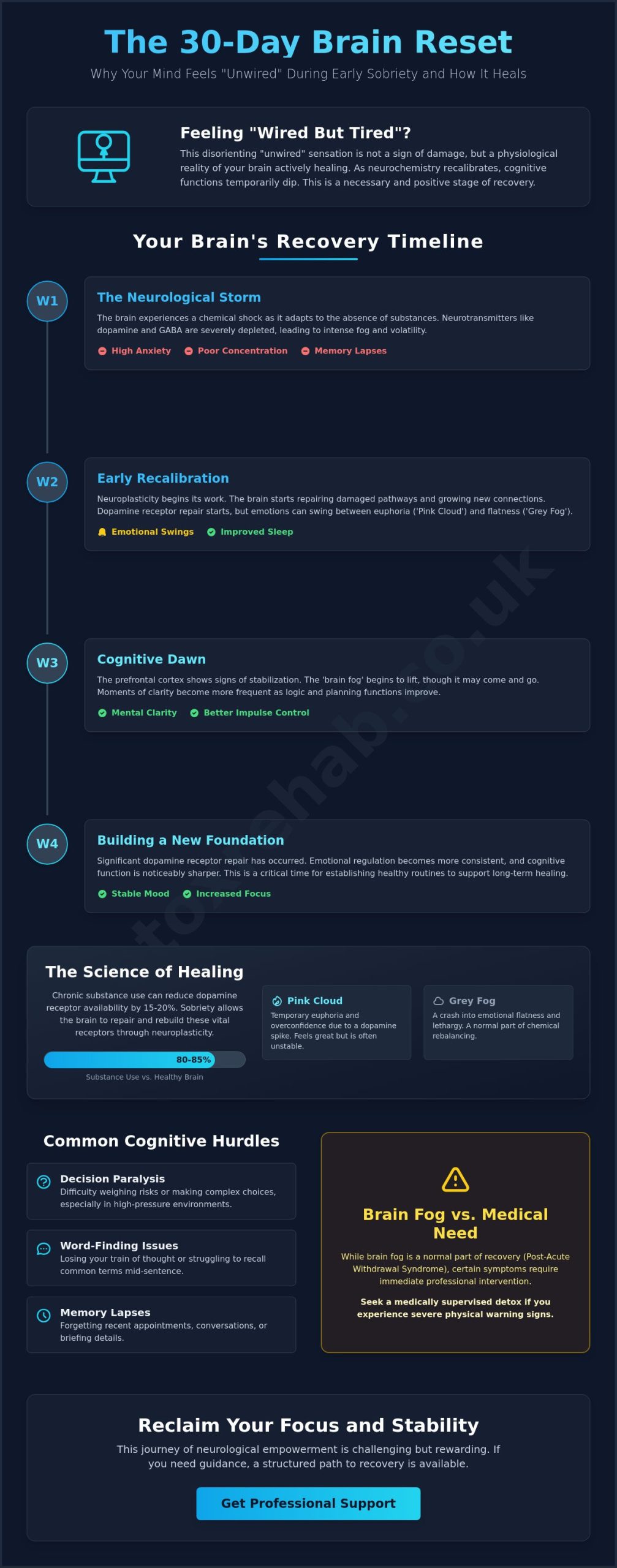
The 30-Day Brain Reset Timeline: A Week-by-Week Guide
Understanding the biological timeline of recovery helps demystify the “unwired” sensation. Your brain isn’t broken; it’s transitioning from a state of chemical dependency to one of self-regulation. This 30-day window is a critical period of neuroplasticity where we help you move from survival to stability.
- Week 1: Physical Detox and Acute Withdrawal Management. Your body focuses on clearing toxins. The central nervous system is hyper-excitable as it adjusts to the absence of alcohol’s sedative effects.
- Week 2: The Emotional Rollercoaster and Sleep Disturbances. As physical symptoms subside, neurochemical imbalances take centre stage. Mood swings are common as your dopamine receptors begin the slow process of up-regulation.
- Week 3: Cognitive Fog and the ‘Wall’ of Boredom. This is often the most challenging phase. The brain feels sluggish, and the lack of artificial stimulation can lead to a profound sense of lethargy.
- Week 4: The Emergence of Clarity and New Baseline Formation. The prefrontal cortex begins to reclaim control. You’ll notice improved decision-making and a more stable emotional baseline.
Week 1 to 2: The Physical Survival Phase
During the first fortnight, your nervous system is incredibly sensitive. Managing the London commute can feel like a sensory assault. The screech of the Northern Line or the crowds at Waterloo can trigger a fight-or-flight response because your brain lacks its usual chemical buffer. We recommend planning your travel during quieter periods or using noise-cancelling technology to manage this sensory overload.
Your brain requires significant energy for repair. We focus on glucose stabilisation and aggressive hydration to prevent the “sugar crashes” that often mimic cravings. Sleep architecture is usually fractured during this time. Alcohol suppresses REM sleep; when you stop, you experience “REM rebound,” which can lead to vivid dreams and frequent waking. This “sober insomnia” is temporary. It’s a sign that your brain is finally catching up on the restorative sleep cycles it has missed for years.
Week 3 to 4: The Psychological Integration
Navigating London’s ‘Wired’ Culture While ‘Unwired’
London’s high-octane environment doesn’t pause because you’ve decided to heal. During The 30-Day Brain Reset: Why Your Mind Feels “Unwired” During Early Sobriety, the city’s constant noise and “always-on” professional culture can heighten your sense of cognitive dissonance. You’re trying to stabilize your neurochemistry while the world around you demands peak performance. This period requires a strategic approach to your surroundings to ensure your progress remains intact.
The capital’s “wired” culture is particularly visible in the Square Mile and Canary Wharf, where professional success is often tethered to social drinking. When your brain is “unwired,” these environments feel louder, brighter, and more chaotic than usual. To manage this, we recommend building a localized sober toolkit. This includes identifying “safe zones” like the 350 acres of Hyde Park or the expansive wilderness of Richmond Park. A 2019 study published in Frontiers in Psychology found that spending just 20 minutes in nature can significantly lower cortisol levels. For a recovering brain, these green spaces act as a vital external regulator for your internal nervous system.
Work-Life Balance for the Recovering Brain
The hustle culture of London, where 12-hour days are often the baseline, acts as a significant trigger. You don’t need to explain your entire history to colleagues to protect your peace. A simple “I’m on a 30-day health kick” or “I’m focusing on my sleep right now” is usually enough to bypass the pressure of after-work drinks. Between high-pressure meetings, find refuge in London’s quiet squares. Places like Postman’s Park or Lincoln’s Inn Fields provide essential micro-breaks. These short windows of silence help you manage the sensory overload that often accompanies The 30-Day Brain Reset: Why Your Mind Feels “Unwired” During Early Sobriety.
Sober Support Networks in the Capital
You aren’t navigating this transition alone. London hosts over 700 AA meetings weekly, alongside a growing number of SMART Recovery groups and alcohol-free social clubs. These communities provide the social scaffolding you need while your brain rewires. Private clinics across the city also offer a “safe harbor,” providing bespoke clinical support that fits around your professional commitments. If the “unwired” feeling becomes unmanageable, seeking professional help is a sign of strength. You can begin by finding local drug detox services in London to ensure your physical safety during the initial stages of withdrawal.
For London professionals balancing recovery with remote work, a dependable connection is essential for accessing online support; you can learn more about the high-speed fibre options available through Broadband Freedom.
Stability is the foundation of recovery. By choosing quiet routes for your commute and scheduling recovery meetings as non-negotiable appointments in your diary, you reclaim control over your environment. If you’re ready to start your journey in a protected, professional environment, contact our London team today for immediate support.
When the ‘Unwired’ Feeling Requires Professional Intervention
Recognising the nuances of The 30-Day Brain Reset: Why Your Mind Feels “Unwired” During Early Sobriety is essential for your safety and long-term success. While a degree of cognitive “fuzziness” is expected as your neurotransmitters recalibrate, it’s vital to distinguish between standard brain fog and dangerous withdrawal symptoms. If you experience severe tremors, profound confusion, or seizures, these are not mere side effects of a resetting mind; they are medical crises. Clinical data indicates that roughly 5% of individuals undergoing alcohol withdrawal may face Delirium Tremens, a condition that requires immediate, 24-hour medical monitoring to prevent life-threatening complications.
At Detox Rehab Clinics UK, we provide the clinical authority needed to manage these risks while maintaining a compassionate, supportive environment. A 30-day residential stay serves as the gold standard for brain repair because it removes you from the daily stressors that trigger cravings. This period of immersion allows your prefrontal cortex, the area responsible for decision-making and impulse control, to begin its vital healing process without the interference of external pressures.
The Safety of Clinical Supervision
Attempting to manage withdrawal in a busy London flat is often counter-productive. The constant noise and frantic energy of the city can exacerbate the sensory sensitivity often felt during early sobriety. Our residential centres provide the “quiet” your brain needs to rewire effectively, and for those seeking specialized intensive clinical trajectories, goodhope-ggz.nl offers a structured environment focused on deep neurological recovery. We integrate nutritional therapy to address the profound vitamin deficiencies common in addiction, using targeted supplements to support neurochemical stability. This medical intervention smooths the transition, making the “unwired” phase shorter and significantly more manageable than it would be if attempted alone.
Reclaiming Your Life in the Capital
We understand that for many high-profile professionals in London, the decision to seek help is complicated by concerns over privacy. We offer bespoke treatment programmes that guarantee total confidentiality, allowing you to focus entirely on your recovery without fear of professional repercussions. Our expert team acts as a steady guide, helping you navigate the complexities of The 30-Day Brain Reset: Why Your Mind Feels “Unwired” During Early Sobriety with dignity and grace. We don’t just treat the addiction; we help you reclaim your cognitive edge and your life.
Taking the first step toward a residential stay is a powerful act of self-care. It provides the structured, purposeful flow your brain requires to move from a state of chaos to one of lasting stability. We are ready to support you with immediate, round-the-clock availability. Contact us today for a free, confidential assessment and let us help you find your way back to clarity.
Begin Your Journey to Lasting Mental Clarity
Understanding The 30-Day Brain Reset: Why Your Mind Feels “Unwired” During Early Sobriety is the first step in reclaiming your life from addiction. You’ve learned that the disorientation you feel isn’t a failure of will; it’s your neurochemistry adjusting to a new, healthier baseline. This biological transition usually stabilises within four weeks, but navigating the high-pressure environment of London during this time requires a structured, clinical approach. Recognising when you need professional intervention ensures that this period of vulnerability becomes a foundation for long-term health.
You don’t have to manage this delicate rewiring process alone. Detox Rehab provides independent advice on more than 300 UK treatment centres, ensuring you find a bespoke programme that fits your specific needs. Our team is based in London and Dorset, offering nationwide coverage and connections to CQC-regulated partner clinics that prioritise your safety and total confidentiality. To find the right path forward, speak with a London-based addiction specialist for free, confidential advice. Your brain has an incredible capacity to heal, and with the right support, that “unwired” feeling will soon give way to a sense of calm, steady strength.
Frequently Asked Questions
Is it normal to feel ‘stupid’ or forgetful in early sobriety?
Yes, experiencing cognitive glitches or memory lapses is a standard part of the neurological healing process. Research published in the Journal of Neuropsychiatry indicates that up to 75% of individuals in early recovery experience some form of cognitive impairment. Your brain is recalibrating its dopamine receptors after long-term suppression. We call this the “unwired” phase; it’s a physical sign that your neural pathways are beginning to repair themselves.
How long does the ‘brain fog’ actually last after quitting alcohol?
Most people find that the most intense brain fog begins to lift between day 14 and day 30 of abstinence. During The 30-Day Brain Reset: Why Your Mind Feels “Unwired” During Early Sobriety, you’ll likely notice gradual improvements in your concentration levels each week. While complex cognitive tasks may take up to 12 months to fully return to baseline, the heavy cloud usually dissipates once your sleep cycles and hydration levels stabilise.
Can the brain fully recover from years of heavy drinking or drug use?
Yes, the human brain possesses a remarkable quality called neuroplasticity, which allows it to reorganise and heal. A 2014 study from the University of Eastern Finland showed that even after years of heavy consumption, brain volume can begin to increase after just 6 weeks of sobriety. While some structural changes may be permanent, your functional ability to learn, feel joy, and make decisions can return to 100% with sustained abstinence and professional clinical support.
Why is my anxiety worse now that I’ve stopped using substances?
Your anxiety feels heightened because your central nervous system is in a state of hyperexcitability after years of being suppressed by depressants. Alcohol artificially boosts GABA, which acts as your brain’s brakes; when you stop, your brain lacks these natural calming chemicals. It’s a physiological rebound effect that typically peaks within the first 72 hours and begins to level off after 14 days. We provide bespoke therapeutic interventions to help you manage these surges safely.
What are the best foods or supplements for a 30-day brain reset?
Focus on a diet rich in Vitamin B1, also known as Thiamine, as 80% of people with alcohol use disorder have a deficiency that impacts memory. Incorporating Omega-3 fatty acids from fish or flaxseeds supports the repair of cell membranes in your neurons. During The 30-Day Brain Reset: Why Your Mind Feels “Unwired” During Early Sobriety, we recommend consuming at least 2 litres of water daily and eating complex carbohydrates to stabilise blood sugar, which prevents mood swings.
Should I take time off work in London to focus on my recovery?
Taking a minimum of 10 to 14 days off work is highly recommended to manage the physical and emotional demands of detoxification. London’s high-pressure corporate environments can trigger stress responses that jeopardise your early progress. Under the Equality Act 2010, addiction is often treated as a disability, providing you with certain workplace protections. Taking this time allows you to establish a solid foundation without the distraction of professional deadlines or commuting stress.
What happens if the ‘unwired’ feeling doesn’t go away after 30 days?
If you still feel “unwired” after 30 days, you may be experiencing Post-Acute Withdrawal Syndrome, or PAWS, which can persist for several months. It’s also possible that an underlying condition, like depression or ADHD, is becoming visible now that the substance use has ceased. In these cases, we recommend a comprehensive clinical assessment to tailor your treatment plan. Recovery isn’t a race, and 15% of individuals require longer-term cognitive support to reach full clarity.