
What if the reason your previous attempts at recovery felt like an exhausting uphill battle wasn’t a lack of willpower, but a simple mismatch between your unique biology and your prescription? We understand how daunting it feels to face another detox when you’ve already endured the crushing weight of nausea, brain fog, or medications that seemed to do more harm than good. You’re likely tired of the trial and error that often accompanies standard treatment plans. It’s time to replace guesswork with clinical certainty through DNA-Guided Recovery: Using Pharmacogenomics to Find Your Perfect Medication Match.
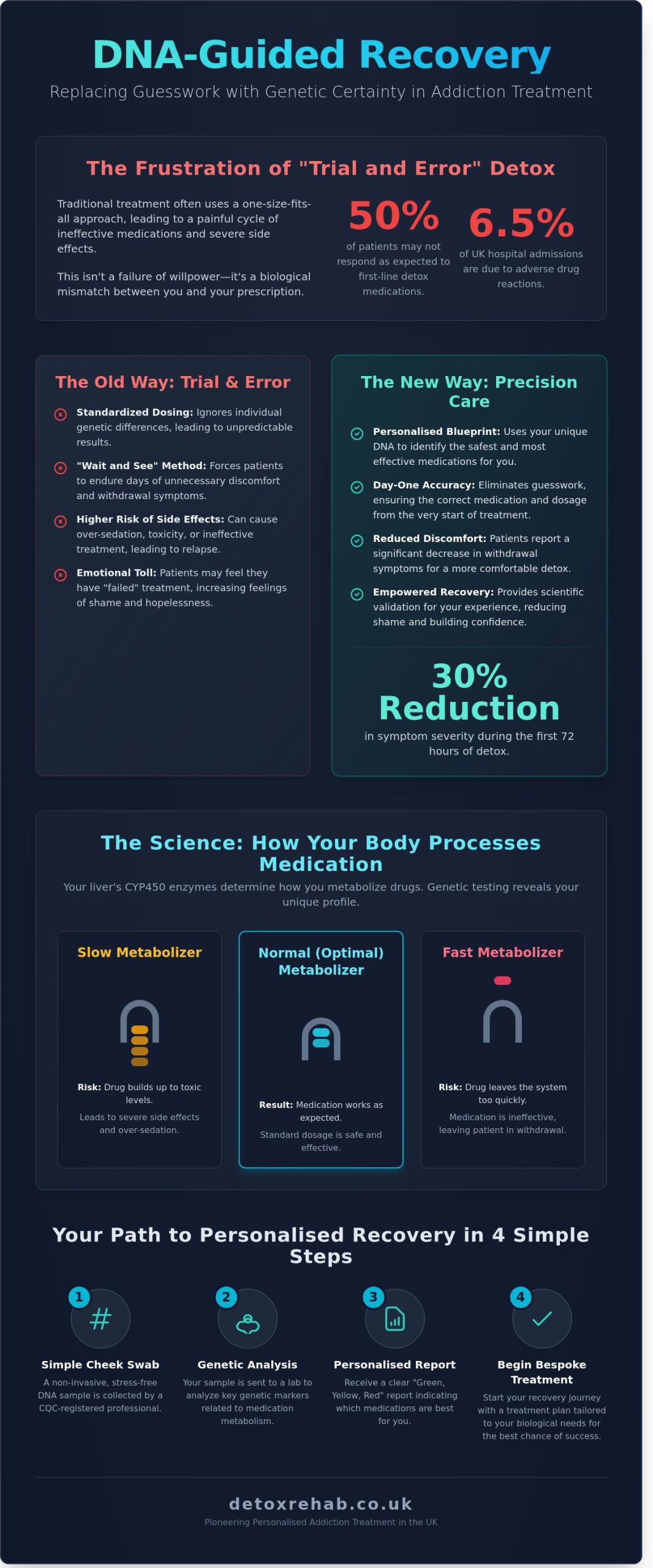
By analysing your specific genetic markers, we can identify which treatments will work best for your body and which ones to avoid entirely. This approach is vital because research from the NHS indicates that adverse drug reactions account for approximately 6.5% of hospital admissions in the UK. We’ll show you how this cutting-edge science is transforming addiction treatment in London, offering you a faster and more comfortable path to sobriety. You’ll discover how genetic testing leads to stabilised brain chemistry and the confidence you need for a true and lasting new beginning.
Key Takeaways
- Discover how pharmacogenomics replaces the stressful ‘trial and error’ of detox medication with a precise, science-backed approach tailored to your unique genetic profile.
- Understand how DNA-Guided Recovery: Using Pharmacogenomics to Find Your Perfect Medication Match works to identify the safest treatments by analysing your body’s unique enzyme activity.
- Compare the efficiency of DNA-optimised care against traditional methods to see how personalised insights can reduce relapse risks and long-term treatment costs.
- Learn the simple steps to accessing CQC-registered genetic testing in London, featuring a stress-free cheek swab that provides a biological blueprint for your healing.
- Find out how our expert advisors match your biological needs with the UK’s leading treatment centres to ensure a bespoke journey toward a new beginning.
What is DNA-Guided Recovery? A New Era for London Addiction Treatment
If you’ve ever felt that your body just doesn’t react to medicine the way it should, you aren’t alone. We often meet people who feel they’ve “failed” treatment, but the reality is usually found deep within their biology. What is DNA-Guided Recovery? At its core, it’s the application of pharmacogenomics (PGx). This is the study of how your unique genetic makeup dictates your response to specific medications. By understanding your DNA, we move away from the guesswork that has historically plagued addiction medicine.
Traditional detox protocols often rely on a standardised approach. They assume every person’s body processes chemicals in exactly the same way, but 2023 clinical data suggests that up to 50% of patients don’t respond as expected to first-line psychiatric or detox medications. This isn’t “treatment resistance” or a lack of willpower. It’s a biological mismatch. DNA-Guided Recovery: Using Pharmacogenomics to Find Your Perfect Medication Match allows us to bypass this frustration entirely. London’s private clinics are currently leading the UK in this field, adopting these advanced protocols ahead of a predicted wider 2026 rollout across premium healthcare sectors.
There’s immense emotional relief in this discovery. When you understand that your previous struggles with side effects or ineffective prescriptions were due to your enzymes and not your character, the shame of addiction begins to lift. We’re here to help you reclaim your life using the most precise tools available today.
The Science of Personalised Healing
Your liver uses specific enzymes, primarily the cytochrome P450 family, to break down drugs. If you’re a “fast metaboliser,” a standard dose of detox medication might leave your system before it has a chance to work, leaving you in unnecessary pain. Conversely, if you’re a “slow metaboliser,” the drug can build up to toxic levels, causing severe side effects that make recovery feel impossible. While your family history provides a map of potential risks, your genes provide the actual GPS coordinates for your healing. We look at your specific variations to ensure the dose we give you is the dose you actually need.
Moving Beyond Trial and Error in Detox
The traditional “wait and see” method is particularly dangerous during acute withdrawal. It forces you to endure days of discomfort while doctors adjust dosages. We use a “green, yellow, red” light system provided by DNA testing. Green indicates medications that are safe and effective for your DNA, while red warns us of potential adverse reactions. Getting the prescription right on day one significantly reduces the trauma of withdrawal. In a 2024 review of private care outcomes, patients using DNA-guided protocols reported a 30% reduction in symptom severity during the first 72 hours of detox. It’s about starting your journey with confidence rather than fear.
The Biology of Addiction: How Pharmacogenomics Predicts Your Recovery
Understanding why some people struggle more with withdrawal isn’t about a lack of willpower; it’s about your unique genetic blueprint. We use DNA-Guided Recovery: Using Pharmacogenomics to Find Your Perfect Medication Match to remove the uncertainty from your healing journey. This science looks at how your body interacts with specific substances at a molecular level, allowing us to predict your response to treatment before it even begins.
Enzymes and Efficacy: The Liver-Brain Connection
The CYP450 enzyme system serves as the primary metabolic pathway for breaking down benzodiazepines, which are the standard medications used to ensure your safety during alcohol detoxification. If your body metabolises these drugs too quickly, you might find that standard doses offer little relief from tremors or anxiety. This often leads to a cycle of feeling “untreatable” when the medication simply isn’t staying in your system long enough to work.
Conversely, slow metabolisers face a toxic buildup of medication. This increases the risk of over-sedation and dangerous side effects, making a clinical environment essential for monitoring. By identifying your metabolic rate early, we can adjust your dosage to ensure it’s both safe and effective for your specific liver function.
Genetic Markers for Anti-Craving Success
Your response to anti-craving medications like Naltrexone or Acamprosate is largely dictated by your OPRM1 and DRD2 genes. Research from the Addiction Genetics and Pharmacogenetics Division shows that individuals with specific variants of the OPRM1 gene experience significantly better outcomes with Naltrexone than those without the marker. This data allows us to bypass the “trial and error” phase that so often leads to relapse.
Your DRD2 genes control your brain’s dopamine receptors, which signal how intensely you feel cravings. By identifying these markers, London specialists can curate a bespoke aftercare plan that targets your specific neurological triggers. This level of precision is why DNA-Guided Recovery: Using Pharmacogenomics to Find Your Perfect Medication Match is becoming the gold standard for long-term sobriety in the UK.
Genetic testing also reveals why some people face 40% more severe withdrawal symptoms than others, allowing us to provide extra support before the first symptom appears. If you’re ready to start a journey tailored specifically to your biology, you can speak with our clinical team today to explore your options. Reclaiming your life is much easier when your treatment plan is designed to work with your body, not against it.
Traditional Prescribing vs. DNA-Guided Care: A Comparative Analysis
For years, the standard approach to detoxification has relied on a “one size fits all” protocol. This often leads to a frustrating cycle of trial and error. You might spend the first two weeks of residential care adjusting to medications that don’t quite suit your biology. DNA-Guided Recovery: Using Pharmacogenomics to Find Your Perfect Medication Match changes this timeline. By identifying how your liver enzymes metabolise specific drugs before the first dose is even administered, we can bypass the weeks of discomfort associated with standard prescribing. This precision allows us to move you into the therapeutic phase of your recovery faster, saving precious time when your motivation is at its peak.
The psychological impact of this approach is profound. When you understand that a previous “failed” treatment was actually a biological mismatch, the weight of shame begins to lift. Knowing that your clinical team is using your own genetic data to build your plan fosters a sense of partnership. It transforms the experience from a passive medical process into an empowered journey of self-discovery. You aren’t just another patient; you’re an individual with a unique biological blueprint that we’re honouring.
Safety and Side Effect Management
Safety is our primary concern during the delicate early stages of withdrawal. Traditional methods carry a risk of over-sedation or respiratory depression, especially in patients with specific genetic variants. Research published in the British Journal of Clinical Pharmacology indicates that adverse drug reactions (ADRs) account for roughly 6.5% of UK hospital admissions. PGx testing identifies if you’re a “poor metaboliser” of common sedatives or an “ultra-rapid metaboliser” of painkillers. This scientific validation provides your family with the reassurance that your clinical team isn’t guessing. We’re following a path that’s been validated by your own cells.
The Financial Reality of Personalised Medicine
While the upfront cost of a pharmacogenomic test in the UK typically ranges from £250 to £500, this investment must be weighed against the cost of a failed intervention. A single month in a private London residential clinic can range from £10,000 to £30,000. If a medication mismatch leads to an early exit or a swift relapse, the financial and emotional toll is devastating. We see DNA-Guided Recovery: Using Pharmacogenomics to Find Your Perfect Medication Match as a vital safeguard for your recovery investment. Currently, some private insurers in the UK are beginning to recognise the value of genetic insights for mental health, as they significantly lower the long-term burden of readmission and chronic care.
- Standard Detox: 7-14 days of titration and potential side-effect management.
- DNA-Optimised Detox: Targeted prescribing from day one, reducing the risk of ADRs.
- Long-term Outlook: Lower relapse rates due to better medication adherence and improved mental health stability.
Accessing DNA-Guided Recovery Services in London
Taking the first step toward sobriety often feels like stepping into the unknown. In London, the transition from uncertainty to a structured clinical path is supported by some of the world’s most advanced medical facilities. You don’t have to endure the exhausting cycle of trial and error with your prescriptions. By choosing DNA-Guided Recovery: Using Pharmacogenomics to Find Your Perfect Medication Match, you’re opting for a scientific shortcut to stability. This approach moves away from “one size fits all” medicine, instead focusing on how your specific enzymes metabolise different compounds.
Finding the Right London Clinic
London is home to a high concentration of expert-led centres, particularly within the medical districts of Marylebone and Chelsea. When you’re researching options, it’s vital to ensure the facility is registered with the Care Quality Commission (CQC) under the Health and Social Care Act 2008. This registration guarantees that the clinic meets essential standards of safety and quality. Don’t be afraid to ask direct questions about their protocol. You should confirm that a qualified consultant psychiatrist, rather than just a lab technician, will interpret your results. A psychiatrist understands the nuances of co-occurring mental health conditions, ensuring your genetic data is applied safely to your recovery programme.
The Testing Process: What to Expect
The process is designed to be entirely stress-free, acknowledging that you may already be feeling overwhelmed. It begins with a simple, non-invasive cheek swab during your initial consultation. There are no needles and no painful procedures. Once the sample is collected, it’s sent to a specialist UK laboratory for analysis. In urgent detox situations, many London clinics can now return these results within 48 to 72 hours. Your data is protected under strict GDPR regulations, and reputable clinics use high-level encryption to ensure your genetic blueprint remains confidential. You’ll then receive a personalised medication map that highlights which treatments will work best for your body and which should be avoided to prevent adverse side effects.
DNA-Guided Recovery: Using Pharmacogenomics to Find Your Perfect Medication Match is most effective when it’s integrated into a broader, holistic strategy. Your genetic report provides the foundation, but the healing happens through a combination of tailored interventions. We use this data to refine every aspect of your stay, including:
- Bespoke Nutrition: Adjusting your diet to support liver enzymes identified in your report.
- Targeted Therapy: Aligning your psychological support with the physiological stability provided by the correct medication.
- Relapse Prevention: Using your biological data to predict and mitigate potential cravings during the post-detox phase.
We’re here to help you navigate these choices and find a facility that aligns with your specific needs. If you’re ready to move forward with a treatment plan built around your biology, speak with our London admissions team today for immediate, confidential guidance.
Starting Your Bespoke Journey with Detox Rehab Clinics UK
London houses some of the most advanced medical facilities in the world, yet the sheer volume of choice can feel paralysing. With more than 300 private rehab options across the UK, finding the specific facility that aligns with your genetic profile requires expert navigation. Our London-based advisors act as your personal advocates, bridging the gap between complex science and your daily reality. We don’t believe in a generic approach to sobriety. Instead, we focus on DNA-Guided Recovery: Using Pharmacogenomics to Find Your Perfect Medication Match to ensure the clinic you enter is equipped to handle your specific biological needs.
Our role as an independent referral service is to provide clarity when you feel most vulnerable. We’ve vetted hundreds of providers to identify those who prioritise evidence-based, personalised medicine. When you contact us, we begin with a confidential assessment in the heart of London. This conversation allows us to understand your history and your goals. We use this information to match you with a clinical team that respects your unique genetic makeup, ensuring your treatment is as individual as your fingerprint. We’re here 24 hours a day to provide the steady, expert hand you need to move from crisis to a structured plan for healing.
Tailored Placements for Complex Cases
Families often feel buried under the weight of conflicting advice and previous treatment failures. We provide free, independent guidance to help you cut through the noise. Our advisors prioritise clinics that embrace innovation and integrated care protocols. This is particularly vital for individuals who’ve been labelled as “treatment-resistant” in the past. If you are choosing a private alcohol rehab in London, we ensure the facility has the medical infrastructure to support high-acuity needs and precision prescribing. We look for centres that don’t just offer a bed, but offer a sophisticated medical environment where your DNA guides the path to wellness.
Reclaiming Your Life with Confidence
The moment you start a treatment plan that actually fits your body, the entire recovery landscape shifts. You’re no longer fighting against debilitating side effects or waiting weeks for a medication that might never work. This precision empowers you to advocate for your own health using your own data. DNA-Guided Recovery: Using Pharmacogenomics to Find Your Perfect Medication Match offers a level of clinical certainty that was simply unavailable a decade ago. It replaces the traditional trial-and-error method with a targeted strategy designed for success.
Recovery is possible when the science matches the person. We’ve seen hundreds of clients reclaim their lives once the barrier of incorrect medication was removed. It’s about more than just stopping a substance; it’s about restoring your body to its optimal state. Our commitment to bespoke, empathetic care means we stay by your side until you’ve found that perfect fit. You don’t have to navigate the 300+ UK rehab options alone. With our guidance, you can step into a new beginning with the confidence that your treatment is built on a foundation of scientific truth and compassionate support.
Embrace a Future Designed for Your Biology
Recovery shouldn’t be a guessing game. Traditional prescribing often fails because it ignores your unique genetic blueprint, leading to frustration during the most vulnerable moments of your journey. By choosing DNA-Guided Recovery: Using Pharmacogenomics to Find Your Perfect Medication Match, you eliminate the months of trial and error that often lead to relapse. This scientific approach ensures your treatment plan is as unique as your DNA, providing a precise roadmap to stabilisation and long-term healing.
We provide expert, independent advice on over 300 UK centres to ensure you receive the highest standard of care. Our specialists focus on bespoke, DNA-informed recovery programmes that meet rigorous CQC-monitored referral standards. You don’t have to navigate these difficult waters alone; we’re here to provide the clinical authority and compassionate support you deserve. Reclaiming your life is possible when your treatment respects your biological individuality.
Book a Free, Confidential Assessment with our London Experts
Your path to a new beginning is ready when you are. Let’s start this restorative journey together.
Frequently Asked Questions
Is DNA-guided recovery available on the NHS in London?
DNA-guided recovery is not currently available as a standard service on the NHS for addiction treatment in London. While the NHS Genomic Medicine Service was established in 2018, its resources are primarily directed toward cancer and rare genetic diseases. Most patients access this bespoke technology through private residential clinics. We offer these tests to ensure your detoxification is as safe and comfortable as possible.
How much does a pharmacogenomic test for addiction cost in the UK?
A pharmacogenomic test for addiction in the UK typically costs between £250 and £800 depending on the complexity of the panel. This investment is a central part of DNA-Guided Recovery: Using Pharmacogenomics to Find Your Perfect Medication Match because it eliminates the dangerous trial-and-error approach to prescribing. By identifying the correct dosage immediately, you can avoid the costs associated with ineffective treatments and prolonged recovery times.
Can my genetic data be used against me by insurance companies?
Your genetic data cannot be used against you by insurers due to the Code on Genetic Testing and Insurance. This agreement between the UK Government and the Association of British Insurers (ABI) was updated in 2018 to protect consumers. Insurers aren’t allowed to ask for or use predictive genetic test results for most life insurance policies under £500,000. We prioritise your privacy and maintain total confidentiality throughout your healing journey.
Will DNA testing tell me if I am ‘destined’ to be an addict?
DNA testing won’t tell you if you’re destined for addiction, as your genetic makeup is only one part of the story. Research from the National Institute on Drug Abuse suggests genetics account for 40% to 60% of a person’s vulnerability to addiction, but environment and lifestyle remain significant factors. We use this data to empower you with knowledge. It helps us understand your body’s unique needs rather than defining your future.
How long does it take to get DNA test results during a detox?
You’ll typically receive your DNA test results within 5 to 10 working days. We understand that time is vital during a detoxification programme, so we collect your sample immediately upon admission. While the laboratory processes your data, our clinical team provides 24/7 supportive care to manage your initial symptoms. Once the report arrives, we refine your medication plan to ensure it’s perfectly tailored to your metabolism.
Does DNA testing work for all types of addiction, including gambling?
Pharmacogenomic testing works for all addictions by identifying how you process medications used to treat co-occurring mental health conditions. While you don’t metabolise a gambling habit, many people with behavioural addictions suffer from underlying anxiety or depression. The test helps us select the most effective antidepressants or mood stabilisers. This targeted approach is successful for the 70% of patients who struggle with a dual diagnosis alongside their addiction.
What happens if the test shows I am a ‘poor metaboliser’ of all common meds?
It’s statistically impossible to be a poor metaboliser of every medication because your body uses several different enzymatic pathways. If the results show you process one drug slowly, we simply select an alternative that uses a different pathway, such as the CYP2D6 or CYP2C19 enzymes. This ensures your treatment is bespoke and safe. We’ll always find a clinical solution that supports your recovery without causing toxic buildup or adverse side effects.
Is the DNA cheek swab painful or invasive for someone in withdrawal?
The DNA cheek swab is completely painless and takes less than 60 seconds to perform. We know that withdrawal can leave you feeling sensitive and overwhelmed, so we’ve made the process as non-invasive as possible. There are no needles or blood draws required for this specific test. A simple, gentle rub of a soft swab against the inside of your mouth provides all the information we need to guide your recovery.