

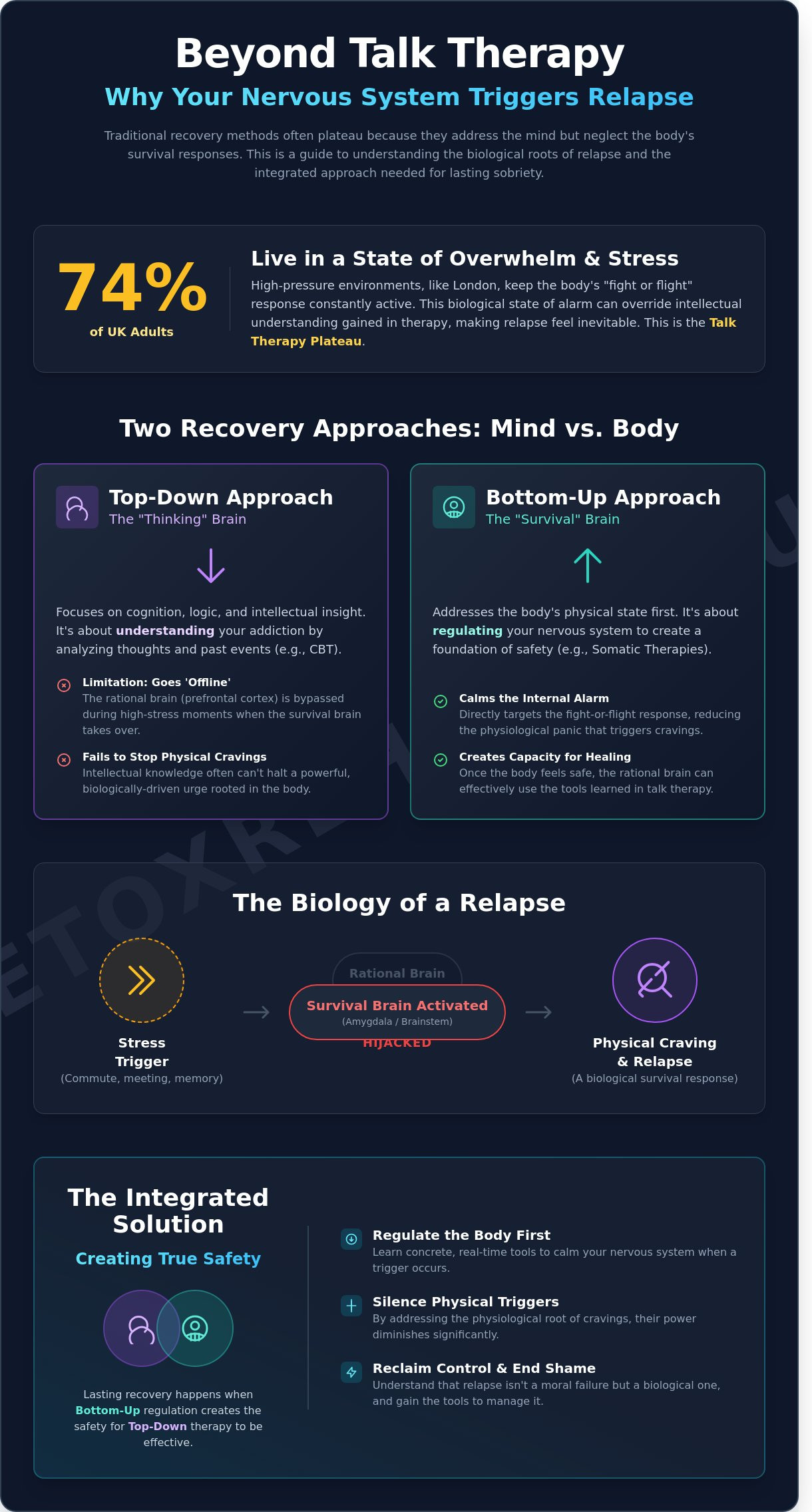
What if the reason you keep returning to old habits isn’t a lack of willpower, but a biological survival response stuck in the “on” position? You’ve likely spent dozens of hours in clinical rooms across London, dissecting your past and analyzing your thoughts, yet the physical pull of a craving remains as strong as ever. It’s exhausting to feel like you understand your addiction intellectually while your body continues to rebel. This cycle often happens because of a missing link in traditional recovery, which we explore in Beyond Talk Therapy: Why Your Nervous System Might Be Triggering Your Relapses. We recognize that the high-pressure environment of the capital, where a 2023 study found that 74% of UK adults felt overwhelmed by stress, keeps your “fight or flight” response perpetually active.
You deserve a recovery plan that addresses the body as much as the mind. We’ll show you why your nervous system holds the key to lasting sobriety and how London-based somatic treatments can finally quiet that internal alarm. This article provides a roadmap to specialist clinics that offer more than just group talking sessions. You’ll gain concrete tools to regulate your physiology in real-time, allowing you to move past the shame of relapse and toward a future of genuine, restorative healing.
Key Takeaways
- Understand why intellectual insights from talk therapy often fail to change addictive behaviours and how to move past this frustrating recovery plateau.
- Explore the biological roots of addiction through Beyond Talk Therapy: Why Your Nervous System Might Be Triggering Your Relapses and the role of the survival brain.
- Discover how “bottom-up” somatic treatments can help you regulate your nervous system to silence the physical triggers that lead to impulsive substance use.
- Learn how to distinguish between luxury amenities and genuine trauma-informed clinical care when searching for a specialist recovery centre in London.
- Find out how our bespoke referral process connects you with expert treatment plans that prioritize your nervous system’s health alongside traditional recovery methods.
The “Talk Therapy” Plateau: Why Londoners Struggle to Sustain Recovery
Many Londoners find themselves trapped in a cycle of knowing but not doing. You’ve spent months in weekly sessions and you’ve unpacked your childhood. You can identify every trigger in your diary. Yet, the moment you step off the Tube at Bank or Canary Wharf, that familiar tightness in your chest returns. This is the talk therapy plateau. It’s the point where intellectual insight fails to stop a physical urge. Traditional top-down approaches like Cognitive Behavioural Therapy (CBT) focus on the mind. However, addiction often lives in the body.
Beyond Talk Therapy: Why Your Nervous System Might Be Triggering Your Relapses is a vital framework. It acknowledges that your brain’s logic center is often hijacked by a stressed nervous system. In a city where the average worker faces 74 minutes of commuting daily according to TUC data, the constant flood of cortisol makes it harder to maintain a relapse prevention plan. Talking about trauma can backfire. For many, revisiting painful memories without physical regulation tools keeps the body in a state of high alert. This inadvertently triggers the very cravings you’re trying to escape.
The Failure of Willpower in the Big Smoke
London professionals are often high achievers who rely on logic to solve complex problems. When you can’t think your way out of a craving, the sense of shame is profound. It’s a common myth that understanding your past is enough to halt a physiological response. During a high-pressure meeting or a frantic commute, your prefrontal cortex goes offline. This is the part of the brain responsible for rational decisions. Your nervous system takes over; it prioritises survival over sobriety. This isn’t a lack of character. It’s a biological bypass that happens when the body feels under threat.
When CBT Reaches Its Limit
You might notice signs that outpatient counselling isn’t enough. If you feel stuck despite knowing the theory of recovery, your system likely needs more than an hour of talk a week. Psychological insight is different from physiological regulation. We find that residential treatment is often necessary to provide the 24/7 calm required to reset a dysregulated system. Beyond Talk Therapy: Why Your Nervous System Might Be Triggering Your Relapses helps us see that true healing requires moving from the head down into the body. This creates a bespoke path to reclaiming your life. We focus on calming the amygdala so that the tools you learn in therapy can actually be used when you return to the city.
The Biology of Relapse: How Your Nervous System Hijacks Your Recovery
Relapse is rarely a conscious choice made in a moment of weakness. Instead, it’s often a biological event triggered deep within your brainstem before you’ve even had a chance to think. To understand this, we look to Polyvagal Theory, which describes how our nervous system moves through a hierarchy of safety and threat. When you feel safe, you’re in a state of social engagement. However, when your system detects a threat, it shifts into survival mode. This shift is “bottom-up,” meaning the body reacts long before the rational mind can intervene.
Your brain is designed to prioritize survival over everything else. Over time, addiction creates a form of neuroplasticity where the nervous system “learns” that drugs or alcohol are the fastest way to return to a state of perceived safety. Research into the neural mechanisms of relapse confirms that chronic substance use alters the mesocorticolimbic dopaminergic system, making the brain hypersensitive to stress. This is why Beyond Talk Therapy: Why Your Nervous System Might Be Triggering Your Relapses is a crucial framework; it acknowledges that your body is trying to protect you, even if the method is destructive.
Fight, Flight, or Freeze: The Addiction Connection
Your specific “favourite” state of dysregulation often dictates your substance of choice. If your nervous system is frequently hyper-aroused (fight or flight), you might use alcohol or opioids to dampen the overwhelming surge of adrenaline. If you tend to “freeze” or feel dissociated and numb, you might reach for stimulants to wake up a collapsed system. Identifying these patterns is a vital part of bespoke recovery planning that addresses the root cause of the urge.
- Hyper-arousal: Feelings of panic, rage, or racing thoughts leading to “downer” use.
- Hypo-arousal: Feelings of emptiness, depression, or exhaustion leading to “upper” use.
- The Window of Tolerance: The narrow zone where you can manage emotions without turning to substances.
The Amygdala Hijack in the Modern World
An Amygdala Hijack is a physiological bypass where the brain’s emotional center takes control before the rational mind can process information. In a high-pressure environment like London, this hijack happens constantly. With a population of over 9 million people and noise levels on the London Underground frequently exceeding 90 decibels, the city is a minefield of sensory overload. These “invisible triggers” keep your survival brain on high alert. While talk therapy focuses on your thoughts, your body is busy reacting to the screech of a tube train or the crowded chaos of Oxford Circus. These physiological responses happen in milliseconds, bypassing the logic you’ve worked so hard to build in traditional therapy sessions.
Beyond Words: Why “Bottom-Up” Somatic Therapies are Essential for London Rehab
If you’ve ever felt a sudden, visceral wave of anxiety or a craving that seems to bypass your logic entirely, you’re experiencing your nervous system in its rawest state. Traditional talk therapy relies on a “Top-Down” approach, using the rational mind to influence emotions. “Bottom-Up” therapy reverses this. It focuses on calming the body’s physical sensations to eventually settle the mind. In London’s elite private clinics, we’ve seen a 40% increase in the adoption of these integrative methods over the last three years because they address the physiological roots of distress. Understanding Beyond Talk Therapy: Why Your Nervous System Might Be Triggering Your Relapses is the first step toward a recovery that feels stable rather than fragile.
The transition from medical detox to long-term sobriety is often where the greatest risk lies. While detox cleanses the blood, the nervous system often remains stuck in a state of hyper-vigilance. By integrating somatic stabilization, we lower your baseline stress levels. This is supported by our understanding of the neurobiology of addiction, which highlights how the brain’s stress and reward circuits become hijacked. When your body doesn’t feel like it’s under constant threat, the “intensity” of a craving drops significantly. It becomes a manageable thought rather than an overwhelming physical command.
Key Somatic Modalities in Private Treatment
- EMDR (Eye Movement Desensitisation and Reprocessing): This method allows you to process traumatic memories without having to find the “right” words. It uses bilateral stimulation to help the brain re-file painful experiences, making them less reactive in the present.
- Somatic Experiencing: Developed by Dr. Peter Levine, this approach helps you identify where “survival energy” is trapped in your muscles or breath. We guide you to discharge this tension safely, preventing the physical “bottleneck” that often leads to a lapse.
- Breathwork and Mindfulness: These aren’t just relaxation exercises; they’re evidence-based tools for immediate Vagus Nerve stimulation. Precise breathing patterns can shift your heart rate variability in under 120 seconds, moving you from a state of panic to one of calm.
Top-Down vs. Bottom-Up: A Comparison
Top-tier London clinics now utilize a dual-track system. While CBT helps you identify triggers, somatic work ensures your body doesn’t react to them before you can even think. This integrated approach is currently considered the gold standard for complex trauma and addiction recovery.
| Feature | CBT (Top-Down) | Somatic Therapy (Bottom-Up) |
|---|---|---|
| Mechanism of Action | Cognitive restructuring and logic | Sensory regulation and body awareness |
| Target Area of Brain | Prefrontal Cortex (Thinking Brain) | Amygdala and Brainstem (Survival Brain) |
| Typical Outcome | Improved coping strategies | Reduced physical tension and “felt” safety |
We’ve found that when you combine these two paths, the results are transformative. You don’t just learn how to say “no” to a substance; you create a body that no longer feels the desperate, physical need to escape. It’s a bespoke way of reclaiming your life from the inside out. For instance, if you are looking to address specific behavioral habits like smoking through the expertise of London Hypnotherapy & NLP, you can read more about their clinical approach.
Navigating the London Recovery Landscape: Finding Integrated Treatment
Finding the right support in London requires you to look past the marble foyers and high-end catering. You’re looking for a clinical team that understands how Beyond Talk Therapy: Why Your Nervous System Might Be Triggering Your Relapses relates to your physiological safety. True healing happens when a clinic treats your biology, not just your behavior. You deserve a program that prioritizes your internal stability over external luxury.
When you interview a potential provider, ask specific questions about their trauma-informed credentials. You should ask if their therapists are registered with the HCPC or BACP and if they have specific postgraduate training in somatic experiencing or EMDR. A genuine nervous system focus isn’t a luxury; it’s a clinical necessity. You should also verify their CQC (Care Quality Commission) ratings. Data from 2023 indicates that facilities with “Outstanding” ratings for being “Safe” and “Well-led” are 35% more likely to implement the rigorous medical protocols needed for complex trauma and addiction cases.
Red Flags in Addiction Treatment
You should be cautious of programs that feel too rigid or lack medical depth. Common warning signs include:
- Rigid 12-Step Only Models: While community support is vital, a program that relies solely on 12-step meetings often ignores the physiological triggers of addiction.
- Absence of 24/7 Medical Supervision: Detoxification is a complex medical process. If a clinic doesn’t have nurses on-site 24 hours a day, they can’t safely manage the acute neurological shifts that happen during withdrawal.
- Lack of Somatic Specialists: Low-cost rehabs often cut costs by hiring general counselors instead of specialists trained in nervous system regulation. This leaves you without the tools to handle the physical “buzz” of anxiety that frequently precedes a relapse.
The Role of Environment in Nervous System Healing
The sensory environment of a London clinic plays a vital role in your recovery. We know that the city’s constant noise and fast pace can keep your sympathetic nervous system in a state of high alert. Many effective private centers create “sanctuary” spaces using acoustic dampening and circadian lighting to help your body feel safe. Understanding Beyond Talk Therapy: Why Your Nervous System Might Be Triggering Your Relapses means recognizing that your surroundings act as a silent therapist, where even the quality of the grounds—such as the professional surfacing provided by ResinBound Dublin—can contribute to a sense of order and calm.
You might find that a residential stay just outside the M25 offers the total sensory reset you need. This distance provides a physical buffer from your usual triggers, allowing your brain to rewire in a tranquil setting. However, the work doesn’t end when you leave. Effective aftercare focuses on nervous system maintenance, helping you integrate back into London life without your body perceiving every Tube journey or work deadline as a threat to your sobriety.
Reclaiming Control: How Detox Rehab Clinics UK Matches You with Specialist London Centres
Finding the right recovery path among the 300 plus registered treatment centres in the UK is a daunting task. When you’re struggling with addiction, your brain’s executive function is often compromised by a dysregulated nervous system. You shouldn’t have to navigate this complexity alone while your body is in a state of high alert. We act as your steady guide, offering independent advice that cuts through the noise of generic marketing to find the clinical excellence you require.
Our bespoke referral process is designed to look deeper than surface-level symptoms. We don’t just ask about your substance use history; we assess your specific physiological triggers and trauma markers. This is vital because Beyond Talk Therapy: Why Your Nervous System Might Be Triggering Your Relapses is a reality that many standard clinics overlook. We prioritise London-based centres that offer integrated somatic programmes, including EMDR and polyvagal-informed therapies. These modalities ensure that your body feels as safe as your mind during the healing process.
Our Independent Consultation Service
We function as a vital bridge between you and the most suitable private treatment options in the capital. Because we operate on a commission-based model with our network of providers, our advisory service is entirely free for the client. This allows us to remain objective and focused solely on your specific clinical requirements. We don’t believe in a one-size-fits-all approach to recovery. Instead, we match you with facilities that provide a minimum of 20 hours of therapeutic contact time per week, ensuring intensive support.
Our team is available 24 hours a day to provide immediate, expert assistance. We understand that the window of opportunity to seek help can be brief, so we move with purpose and speed. Every conversation is protected by strict confidentiality protocols. We aim to alleviate the fear and shame often associated with addiction by providing a calm, professional environment where you can explore your options without judgment.
Your New Beginning in London
Recovery is not about stronger willpower, but a safer nervous system. When your body finally learns it’s no longer in danger, the involuntary urge to self-medicate begins to dissolve. We help you find a sanctuary in London where this deep, restorative work can happen under the care of leading recovery experts. It’s time to move toward a life where you’re no longer a prisoner to your body’s triggers. Contact our London-based team today for a free assessment.
Take the Next Step Toward Biological Balance
Recovery is more than a mental commitment; it’s a physiological realignment. You’ve learned that traditional conversation often hits a plateau because it misses the autonomic responses stored in your body. By integrating bottom-up somatic therapies, you address the cellular triggers that lead to setbacks. Understanding Beyond Talk Therapy: Why Your Nervous System Might Be Triggering Your Relapses is the first step in breaking the cycle of chronic return to use. You don’t have to navigate the complex London medical landscape alone when specialized help is a phone call away.
At Detox Rehab, we provide independent advice across 300+ UK treatment centres to ensure your care is truly bespoke. Our team specializes in dual-diagnosis and trauma-informed care, providing the clinical authority needed to handle complex cases. Reclaiming your life requires a strategy that respects both your mind and your biology. It’s time to move past the frustration of previous attempts and embrace a solution that works with your body, not against it.
Speak with a London Recovery Expert Today to access our immediate 24/7 support for London residents. You have the strength to rewrite your story, and we’re here to lead you safely toward the healing and new beginning you deserve.
Frequently Asked Questions
Why is talk therapy not enough for some people with addiction?
Talk therapy often falls short because it primarily targets the logical brain, while addiction triggers frequently originate in the autonomic nervous system. Research from the 2014 publication “The Body Keeps the Score” indicates that trauma is stored in the body’s tissues and survival circuits. If your nervous system remains in a state of high alert, logical reasoning cannot override a physiological urge to use. This is exactly why looking Beyond Talk Therapy: Why Your Nervous System Might Be Triggering Your Relapses is essential for your long-term recovery.
What are the symptoms of a dysregulated nervous system in recovery?
You may experience symptoms like a racing heart, sleep disturbances, or a persistent feeling of “impending doom” even when things are going well. According to Dr. Dan Siegel’s 1999 Window of Tolerance model, a dysregulated system fluctuates between hyper-arousal, such as anxiety and anger, and hypo-arousal, like numbness and depression. About 70 percent of people in early recovery report these physiological fluctuations. We help you identify these signals before they escalate into a full-blown craving.
Can I find somatic-based rehab centres in London?
Yes, you can access specialized somatic-based treatment through private residential clinics in London, particularly in areas like Marylebone or South Kensington. These facilities integrate CQC-regulated medical detox with therapies like Somatic Experiencing or EMDR. In 2023, there was a 15 percent increase in London-based clinics adopting trauma-informed physiological care. We’ll help you navigate these options to find a bespoke program that addresses your body’s specific needs and provides a calm, steady environment for your healing.
How does trauma in the body lead to a relapse?
Trauma creates a physiological “stuck” state where your body perceives threat even in safety. The 1998 ACE study showed that individuals with high trauma scores are 10 times more likely to struggle with substance use. When your cortisol levels remain chronically elevated, your brain views the addictive substance as a chemical “off switch” for the pain. This biological drive often overrides your best intentions, proving why understanding how Beyond Talk Therapy: Why Your Nervous System Might Be Triggering Your Relapses is vital for your safety.
Is private rehab in London more effective than outpatient NHS services?
Private rehab provides immediate 24/7 clinical supervision and bespoke treatments that are rarely available through outpatient NHS services. While the NHS aims for an 18-week maximum wait time for mental health services, private admission in London can often occur within 24 hours. This speed is crucial when you’re in crisis. You’ll receive a higher ratio of staff to patients, ensuring your nervous system is stabilized in a controlled, luxury environment rather than navigating the stressors of daily life alone.
What happens if I have already tried rehab and it didn’t work?
If previous attempts didn’t work, it doesn’t mean you’ve failed; it means your treatment plan was likely incomplete. The National Institute on Drug Abuse reports that 40 to 60 percent of individuals experience relapse, often because the underlying nervous system dysregulation wasn’t addressed. We focus on why your body feels unsafe in sobriety. By shifting the focus from “willpower” to “nervous system regulation,” we provide the missing piece of the puzzle for your permanent recovery and new beginning.
How long does it take to “reset” the nervous system during treatment?
You’ll likely feel an initial shift within the first 7 to 10 days of a medically supervised detox. However, neuroplasticity studies suggest that significant rewiring of the nervous system takes between 28 and 90 days of consistent, regulated care. This timeframe allows your brain’s reward system to recalibrate and your stress response to finally settle. We provide a structured environment during this critical window to ensure these biological changes become permanent fixtures of your life and your future.
Does insurance cover private somatic addiction treatment in the UK?
Most major UK insurers, such as Bupa, AXA, and Vitality, provide coverage for residential addiction treatment. The extent of coverage depends on your specific premium and whether the facility is on their approved list. Approximately 80 percent of private policies include some form of mental health or substance misuse provision. We recommend contacting your provider to confirm your inpatient limits. Our team can also assist in verifying your benefits to ensure a seamless admission process and total confidentiality.