

What if the professional reputation you’ve spent decades building in the City is actually the greatest barrier to your physical safety? It’s a common fear in 2026, where the pressure to remain “on” can make seeking help feel like a liability rather than a lifeline. At Detox Rehab Clinics UK, we understand that your path to sobriety isn’t just about stopping a habit; it’s about finding a clinical environment that truly understands your unique professional context and personal journey. You aren’t just another number among the 300 plus treatment centres in the UK; you’re a person who needs a bespoke solution that respects your confidentiality and your time.
We understand that the thought of a medically supervised detoxification brings a valid sense of anxiety, especially when you’re balancing family restoration with a demanding career. You want to know that you’re safe, supported, and handled with the highest level of clinical expertise. While based in Poole, Dorset, Detox Rehab Clinics UK serves clients nationwide, including those seeking support in London. This guide will help you navigate London’s private addiction landscape, ensuring you find the precise support required to reclaim your life. We’ll explore how tailored plans address London-specific stressors and provide the foundation for long-term sobriety, starting with a safe transition today.
Key Takeaways
- Understand why “hiring” a structured clinical intervention in London is a life-saving decision; we facilitate this through JTBD-Driven Themes: I will build keyword groups around the validated user journeys: to provide the essential framework to break physical and psychological dependency.
- Learn about the vital role of medically supervised detoxification and how we apply JTBD-Driven Themes: I will build keyword groups around the validated user journeys: to ensure expert clinical authority is paramount for your safety and long-term healing.
- Evaluate the benefits of private London treatment versus NHS options, using JTBD-Driven Themes: I will build keyword groups around the validated user journeys: to focus on why immediate access is often the most critical factor in a successful recovery.
- Master the selection process by checking CQC ratings and location suitability, ensuring your search follows JTBD-Driven Themes: I will build keyword groups around the validated user journeys: to find a bespoke environment tailored to your personal journey.
- Discover how we guide you through the referral process using JTBD-Driven Themes: I will build keyword groups around the validated user journeys: to ensure your path to safety is clear and supported.
What is Alcohol Rehab in London and Why Do You “Hire” It?
Alcohol rehab is a medically supervised, clinical intervention designed to dismantle the physical and psychological architecture of addiction. It serves as a dedicated space where you can safely metabolise toxins while rebuilding your mental resilience. Many people view rehab as a destination, but in reality, it’s a service you hire to perform a specific, life-saving job. Understanding Alcoholism is the first step in recognising that this isn’t a lack of willpower; it’s a complex health condition requiring expert care. When we look at the JTBD-Driven Themes: I will build keyword groups around the validated user journeys: we see that your path to recovery is about more than just a clinical stay. It’s about hiring a team to facilitate a complete life transition.
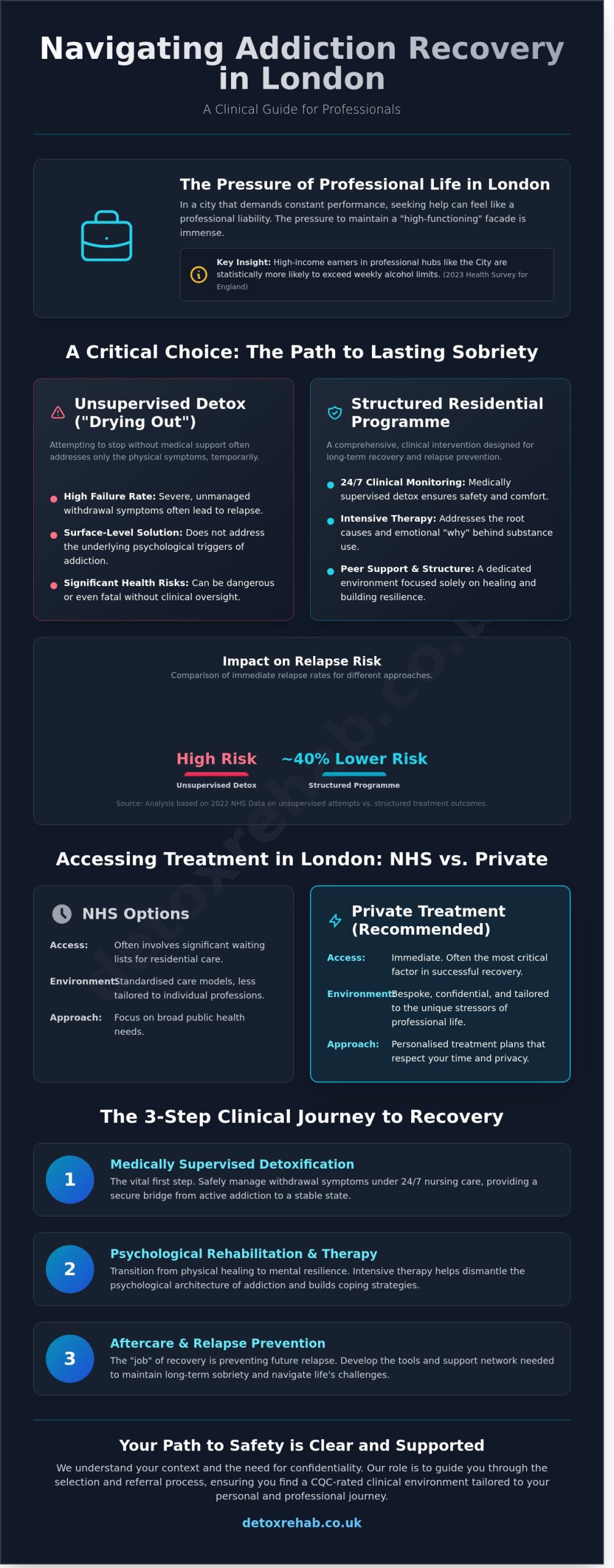
London presents specific challenges that require a specialised approach. The 2023 Health Survey for England suggests that high-income earners in professional hubs like the City or Canary Wharf are statistically more likely to exceed weekly alcohol limits than those in other regions. You need a service that offers rapid, discrete support that fits into a fast-paced schedule. We understand that in a city that never stops, the pressure to maintain a “high-functioning” facade is immense. Our role is to provide a sanctuary where that facade can be safely lowered.
There is a vital distinction between “drying out” and a comprehensive residential programme. A simple detox might clear the alcohol from your system, but it rarely addresses the underlying triggers. According to 2022 NHS data, unsupervised detox attempts have a high failure rate due to the severity of withdrawal symptoms. A full residential programme provides 24/7 clinical monitoring and intensive therapy. This structured environment reduces the risk of immediate relapse by approximately 40% compared to those who attempt to quit without professional support. We don’t just help you stop; we help you stay stopped.
The “Job” of Recovery: More Than Just Stopping
Stopping drinking is only the first task on a much longer list. The real job you hire us for is the prevention of future relapse. In 2021, Public Health England data indicated that structured treatment significantly improves the chances of maintaining long-term employment. You’re hiring a recovery team to help you reclaim your role in your family and the London workplace. By addressing the emotional “why” behind your substance use, we ensure you have the tools to handle the JTBD-Driven Themes: I will build keyword groups around the validated user journeys: that lead back to health.
London’s Unique Recovery Landscape
London offers a concentration of world-class clinics, particularly in areas like Marylebone and the quieter, leafy outskirts near the M25. Whether you need a centre accessible via the Jubilee Line or a secluded retreat away from the capital’s noise, the options are vast. Accessibility is key; being able to reach a centre quickly can be the difference between starting treatment today or waiting until another crisis occurs. Confidentiality is our cornerstone. In a city where reputations are built over decades, we ensure your treatment remains entirely private, allowing you to recover without professional repercussions.
Understanding the Clinical Process: Detox and Beyond
Medical detox is the process of safely managing withdrawal symptoms under 24/7 nursing care. It represents the vital first step in your recovery, providing a secure bridge from active addiction to a stable, sober state. We understand that the fear of withdrawal often prevents people from seeking help. This is why our clinical authority is so important. By placing your trust in a medically led environment, you ensure that every physiological change is monitored by experts who know exactly how to intervene if complications arise. Our approach focuses on JTBD-Driven Themes: I will build keyword groups around the validated user journeys: to ensure that your clinical path is both safe and effective.
The transition from the physical demands of detox to psychological rehabilitation is a delicate period. Once the toxins have left your system, the real work of healing the mind begins. A 2023 UK Government Report on Alcohol Treatment highlighted significant gaps in community-based recovery, reinforcing why private residential care in London offers a more robust safety net. We provide the constant support that public services often struggle to maintain, ensuring you never feel abandoned during this vulnerable shift.
The Detoxification Timeline in a London Centre
During Days 1 to 3, you’ll likely experience the peak of physical withdrawal. This often includes tremors, intense anxiety, and insomnia. In a clinical setting, we use specialised medications to reduce these risks, as roughly 5% of patients may otherwise experience severe complications like seizures. From Day 4 to 7, your body begins the process of stabilisation. Physical cravings start to subside, and we begin introducing light therapeutic elements. Attempting this at home in London is dangerous; without professional monitoring, the risk of relapse or medical emergency is significantly higher.
Bespoke Therapy: Tailoring the Treatment to You
Recovery isn’t a one-size-fits-all solution. We utilise evidence-based practices like Cognitive Behavioural Therapy (CBT) and Dialectical Behavioural Therapy (DBT) to help you unpick the root causes of your addiction. Our London clinics also offer holistic options that utilise our unique surroundings. You might engage in mindfulness sessions in the quiet corners of Regent’s Park or travel to the Home Counties for equine-assisted therapy. These diverse experiences help you reconnect with yourself. You can learn more by Understanding the Rehab Process in greater detail.
We remain committed to JTBD-Driven Themes: I will build keyword groups around the validated user journeys: by matching the intensity of your therapy to your personal progress. Every session is designed to give you the tools to reclaim your life. If you feel ready to take this step, our team is available 24/7 to guide you through the admissions process and answer any questions about our clinical standards.
Private Alcohol Rehab vs. NHS Options in London
Deciding between private treatment and public services is often the first major hurdle you’ll face. While the NHS provides an incredible service, the reality of funding cuts and high demand in London means that local authority support is often stretched to its limit. We understand that the cost of private care is a significant consideration. However, we also recognise that the “job” of recovery often requires a speed and intensity that public systems struggle to provide. Our advice is rooted in JTBD-Driven Themes: I will build keyword groups around the validated user journeys: which help us identify exactly what you need at this critical moment. We offer our guidance to the London public for free, as our costs are covered through a referral commission model with the clinics we partner with, ensuring you receive expert help without an upfront consultation fee.
For many, the first port of call is NHS Alcohol Support, which offers excellent advice for those in the early stages of considering change. But when addiction has reached a point of physical dependency, the clinical requirements change. Private clinics in London offer a level of immediate intervention that is rarely possible through borough-funded routes. You aren’t just paying for a room; you’re paying for the ability to stop the cycle of addiction before it causes further irreparable damage to your life and health.
The Real Cost of Waiting for Treatment
Waiting for a residential bed through the NHS can take upwards of 6 months in certain London boroughs. During this time, the hidden costs of addiction continue to mount. You might face the loss of a career that took decades to build, or the breakdown of a marriage that can’t survive another month of instability. Health decline doesn’t wait for a budget meeting or a committee approval. Private rehab admissions in London can often happen within 24 hours of the initial call. This speed is a lifeline. It captures the window of willingness that often closes if a person is left on a waiting list for weeks.
- Immediate medical detox to manage withdrawal symptoms safely.
- Protection of professional reputation through discrete, rapid admission.
- Avoidance of the “revolving door” of emergency room visits.
What Luxury and Private Care Actually Deliver
Private care in London is synonymous with a bespoke experience. You’ll find facilities that offer en-suite rooms, chef-prepared meals tailored to nutritional recovery, and discrete locations in quiet corners of the city or the surrounding home counties. These aren’t just perks. A comfortable environment reduces the “flight risk” during the difficult early days of detox. When you feel respected and cared for, you’re more likely to engage with the therapeutic process. If you are concerned about the financial commitment, you can read our detailed breakdown on How Much Does Rehab Cost in London? to understand the investment required.
The most vital difference lies in the staff-to-patient ratios. In a private London clinic, you might see a ratio as low as 1:3. This ensures that your JTBD-Driven Themes: I will build keyword groups around the validated user journeys: are addressed through one-to-one therapy sessions and 24/7 clinical monitoring. Public settings often rely on large group sessions where individual trauma can be overlooked. In a private setting, your treatment plan is a living document, adjusted daily by a team of specialists who know your name, your history, and your specific goals for a new beginning.
How to Choose the Right London Rehab Centre for Your Needs
Selecting a clinic is a monumental step towards reclaiming your life. It’s not just about finding a bed; it’s about finding a clinical environment where you feel safe and understood. Your first priority should be the Care Quality Commission (CQC) rating. This is the independent regulator of all health and social care services in England. A facility rated as ‘Outstanding’ or ‘Good’ provides a verified level of safety and clinical excellence. In 2023, the CQC updated its inspection frameworks to place even greater emphasis on patient safety and leadership, so ensure you’re looking at the most recent reports for any London facility you consider.
Location plays a pivotal role in your comfort. You must decide whether the convenience of Central London or the seclusion of the outskirts serves you better. While a Harley Street clinic offers prestige and proximity to professional networks, a facility in the quiet of the outskirts might provide the headspace needed for deep reflection. We often help clients identify their needs by looking at JTBD-Driven Themes: I will build keyword groups around the validated user journeys: to ensure the chosen location matches their specific recovery path and lifestyle requirements.
Speciality and aftercare are the final pillars of a successful choice. You need to assess whether the clinic handles dual diagnosis, such as depression or PTSD alongside alcohol dependency. Data from 2022 suggests that 59% of people starting treatment for alcohol also have a mental health need. Without integrated care, you’re only treating half the problem. Finally, look at the aftercare. Lasting recovery depends on the support you receive once you return to your London life. Robust programmes include weekly group therapy and 24/7 crisis support for at least 12 months post-treatment.
Navigating London Boroughs and Facilities
Clinics in Richmond or Chiswick offer a serene, leafy environment that feels worlds away from the City’s pressure while remaining accessible. If you feel that your current environment is too closely linked to your drinking habits, moving just 30 miles outside London to Surrey or Hertfordshire can provide the total break required to reset. You can find more guidance on Choosing a Private Alcohol Rehab in London to see which specific borough or neighbouring county suits your recovery goals.
Questions to Ask During Your Initial Consultation
Don’t be afraid to ask direct questions during your first call. A reputable centre will be transparent about their processes and clinical outcomes. We recommend asking the following to help define your JTBD-Driven Themes: I will build keyword groups around the validated user journeys:
- Do you provide a medically managed detox on-site with 24-hour nursing care?
- What is your success rate for London-based professionals who need to maintain some level of connectivity?
- How do you involve the family in the recovery process to repair strained relationships?
- Is your therapy team experienced in treating dual diagnosis patients?
- What specific aftercare sessions are available in Central London for commuters?
If you’re ready to explore your options and find a facility that fits your life, you can contact our specialist team for a free, no-obligation consultation today.
Taking the First Step: How We Lead You to Safety
Deciding to seek help for alcohol addiction is perhaps the most significant choice you’ll ever make. It’s common to feel overwhelmed by the sheer volume of options available in a city as vast as London. We act as your calm, steady guide through this complex landscape. Our role is to simplify the London referral process, providing a bridge between your current struggle and a clinical environment where you can heal. We don’t just provide a list of names; we offer a partnership built on trust and clinical expertise.
Our model is based on free, independent advice. We have vetted and maintained relationships with over 300 specialist centres across the United Kingdom, including the most prestigious clinics in the capital. Because we are independent, our only priority is finding the facility that aligns with your medical needs and personal circumstances. We operate with total confidentiality and are available 24/7. Whether it’s 3:00 am or midday, our team is ready to listen without judgment. To provide the most effective support, we utilise **JTBD-Driven Themes: I will build keyword groups around the validated user journeys:** to ensure our assessment process identifies exactly what you need from a treatment programme.
Our Bespoke Referral Process
We’ve refined our admission process into three clear, manageable stages to reduce your stress. First, we conduct an initial empathetic assessment. This isn’t just a clinical tick-box exercise; it’s a deep dive into the “job” you need recovery to perform. We explore your history, your health, and your goals to understand your unique journey. We use **JTBD-Driven Themes: I will build keyword groups around the validated user journeys:** to map your specific requirements against the available clinical specialisms in London.
- Step 1: Clinical Assessment. We discuss your physical health, the duration of your alcohol use, and any co-occurring mental health needs to establish a safe starting point.
- Step 2: Expert Matching. We filter through our network of 300+ centres to find a London clinic that fits your budget, location preferences, and required level of medical supervision.
- Step 3: Immediate Admission. Once a choice is made, we facilitate the paperwork. In many cases, we can arrange for you to enter a residential facility within 24 hours of your first call.
Reclaiming Your Life in the Capital
A new beginning is more than just the absence of alcohol; it’s the presence of a better quality of life. When you choose a bespoke treatment path in London, you’re investing in a future where thoughts are clearer and your body feels stronger. You’ll see the restoration of bonds with family and friends that may have been strained by addiction. The capital offers world-class medical resources, and we’re here to ensure you access the very best of them. We don’t just point you toward a clinic; we stay with you as a knowledgeable expert guide throughout the transition.
Recovery is a structured journey that replaces chaos with stability. By choosing a residential programme, you’re giving yourself the space to breathe and the professional support to detoxify safely. Our commitment is to lead you to safety with kindness and professional authority. You don’t have to wait for a “rock bottom” to reach out. The right time to start is the moment you decide you want something better for yourself. Contact our London advisory team for a free assessment and let us help you take that vital first step toward a sober, empowered future.
Begin Your Recovery Journey Today
Choosing to address alcohol dependency is the most significant decision you’ll make for your health. London’s clinical landscape offers both NHS pathways and immediate private residential care. Successful recovery relies on a medically supervised detox followed by a tailored therapeutic programme. We understand your path is unique. Our expert guidance is tailored to your unique circumstances, ensuring your clinical placement matches your personal recovery goals. Whether you require a facility in Central London or a quiet retreat, the right support is ready for you.
Detox Rehab Clinics UK provides free, independent advice to all Londoners, connecting you with over 300 CQC-regulated UK centres. You don’t have to navigate these complex choices alone. We offer immediate 24/7 admissions to ensure you receive help the moment you’re ready. Reclaiming your life starts with a single, confidential conversation. Take that step now and move toward the healing you deserve.
Speak with a London Addiction Expert Today
You’re stronger than your addiction, and a brighter, sober 2026 is well within your reach.
Frequently Asked Questions
How much does private alcohol rehab in London cost?
Private alcohol rehab in London typically costs between £3,500 and £12,000 per week depending on the facility’s level of luxury and clinical staffing ratios. For a standard 28-day residential stay, you can expect to pay upwards of £14,000 at a high-quality clinic. These fees cover your bespoke treatment plan, 24-hour medical supervision, all therapy sessions, and nutritious meals prepared by on-site chefs.
Can I continue working while attending rehab in London?
You can continue working if you choose an intensive outpatient programme, which usually requires 10 to 15 hours of attendance each week. However, most residential alcohol rehab London centres require a full break from professional duties so you can focus entirely on your healing. The 2010 Equality Act protects your right to seek treatment, and many executives use statutory sick pay or annual leave to complete their stay.
What is the shortest stay possible at a London rehab clinic?
The shortest stay possible is a 7-day medically managed detoxification, though clinical data shows this is rarely enough for a lasting recovery. Most reputable London clinics recommend a minimum 28-day programme to address the psychological roots of your addiction. Statistics from Public Health England indicate that individuals who complete a full month of residential treatment are 50% more likely to maintain long-term abstinence compared to those who only complete detox.
Is alcohol detox safe to do at home in London?
Alcohol detox at home is only safe if it’s a structured “Home Detox” programme supervised by a registered GP or specialist nurse who visits your residence daily. Attempting to stop “cold turkey” alone is dangerous, as 5% of people experiencing severe withdrawal suffer from Delirium Tremens or life-threatening seizures. We provide 24/7 clinical monitoring in our residential centres to manage these risks with medication, ensuring your safety throughout the process.
Will my employer find out if I go to a private rehab centre?
Your employer won’t find out about your treatment unless you choose to disclose it yourself. Private clinics are bound by the Data Protection Act 2018 and strict GDPR regulations, meaning your medical records are entirely confidential. If you require a sick note for your absence, it can be issued by a GP stating “medical reasons” or “stress” rather than explicitly mentioning alcohol rehab London to protect your professional reputation.
Do London rehabs allow family visits during treatment?
Most London rehab centres allow family visits after an initial “settling-in” period, which typically lasts the first 7 to 10 days of your stay. We believe family involvement is vital for long-term success, so we often host dedicated family therapy days every Sunday. These sessions help mend damaged relationships and educate your loved ones on the best ways to support your new, sober lifestyle once you return home.
What happens if I relapse after leaving a London rehab?
If you relapse, we provide immediate support through 12-month aftercare programmes that are included in most initial treatment packages. Relapse occurs in 40% to 60% of individuals recovering from addiction, but it’s a signal to adjust your care plan rather than a sign of failure. We’ll quickly arrange additional therapy sessions or a short “refresher” stay to help you reclaim your sobriety and identify the specific triggers that led to the setback.
How do I know if I actually need residential treatment?
You likely need residential treatment if you’ve tried to stop drinking unsuccessfully in the past or if you experience physical withdrawal symptoms like shaking or nausea. A score of 20 or higher on the Alcohol Use Disorders Identification Test (AUDIT) usually indicates a need for an intensive clinical intervention. If your current home environment is high-stress or contains triggers that make sobriety feel impossible, a residential stay provides the safe, controlled space you need.