

What if the difference between a temporary “dry spell” and lifelong recovery was simply the clinical philosophy of your chosen facility? As we move through 2026, the search for addiction treatment centres in London has become a complex labyrinth of over 150 competing facilities, which can leave you feeling more exhausted than when you began. You likely feel that finding a safe haven shouldn’t feel like a high-stakes gamble, especially when your health and future are on the line. We understand that the fear of accidentally choosing a “rehab mill” instead of a genuine clinical environment is a heavy burden to carry alone.
You deserve a clear path to sobriety that prioritises your confidentiality and unique medical requirements. This guide provides the independent, expert oversight you need to distinguish between the superficial luxury of Harley Street and the deep, restorative care of specialised residential units. We will walk you through the essential criteria for 2026, from the latest CQC inspection outcomes to bespoke detoxification protocols, so you can reclaim your life with absolute confidence. It’s time to move past the confusion and find the steady, professional support you need to start your new beginning.
Key Takeaways
- Understand what distinguishes a world-class facility in the 2026 market and why London remains a global leader for psychiatric and recovery expertise.
- Navigate the choice between immersive residential stays and flexible outpatient programmes designed to balance your recovery with a demanding professional life.
- Compare the immediate accessibility of private care with current NHS waiting times to find the most suitable addiction treatment centres in London for your needs.
- Utilise our expert checklist to evaluate clinics, ensuring they provide the vital dual-diagnosis care necessary for treating both addiction and underlying mental health.
- Learn how a bespoke, confidential assessment can simplify your search and secure an immediate placement in a facility tailored specifically to your healing journey.
Navigating Addiction Treatment Centres in London
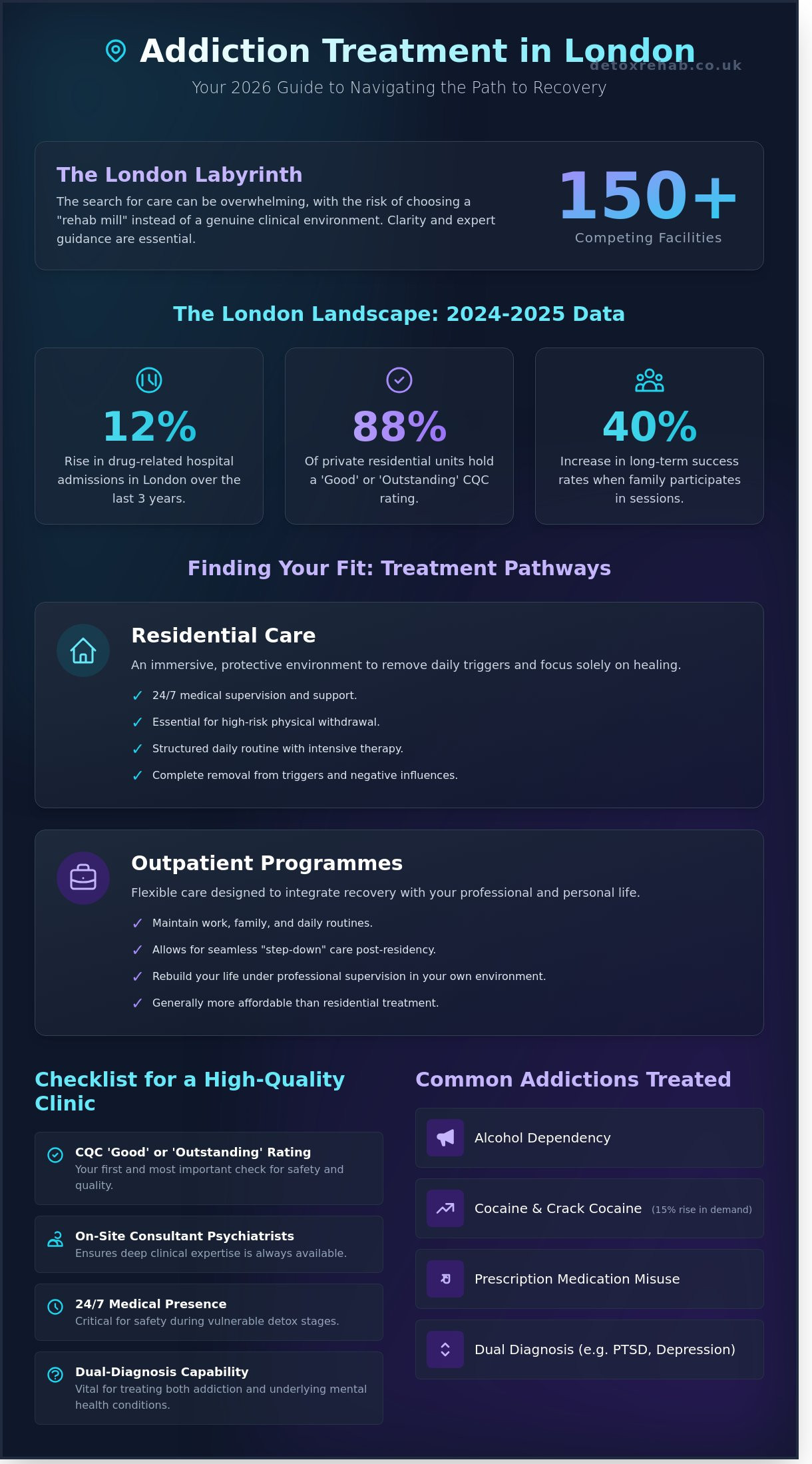
You’ve taken a brave and vital step by acknowledging that things need to change. Finding the right path through the recovery landscape feels overwhelming, but we’re here to guide you with clarity and compassion. In the 2026 market, high-quality addiction treatment centres in London are no longer defined just by comfortable rooms or prestigious postcodes. True excellence is now measured by rigorous clinical outcomes, the presence of on-site consultant psychiatrists, and a 24/7 medical presence that ensures your safety during the most vulnerable stages of detox. London stands as a global hub for psychiatric care, housing some of the world’s most published experts in neurobiology and trauma-informed recovery.
Urban life brings intense pressures that can accelerate the cycle of dependency. Recent 2024 data from the Office for National Statistics indicates that drug-related hospital admissions in London boroughs have risen by 12% over the last three years. This makes understanding drug rehabilitation essential before you commit to a specific facility. We’ll help you decode the clinical jargon and focus on what truly facilitates long-term sobriety. Our goal is to replace your uncertainty with a structured, medical, and deeply human plan for healing.
The Scope of Addiction Services in the Capital
London offers a spectrum of care that few cities globally can match. You’ll find ultra-private clinics in Harley Street where bespoke detoxification programmes might cost upwards of £15,000 per week, alongside highly effective community-led hubs and residential centres in quieter leafy suburbs. Your first check must always be the Care Quality Commission (CQC) rating. As of January 2025, approximately 88% of London’s private residential units hold a ‘Good’ or ‘Outstanding’ status. These facilities are equipped to treat a broad range of challenges, including:
- Chronic alcohol dependency and high-functioning alcoholism.
- Cocaine and crack cocaine addiction, which saw a 15% increase in London treatment demand last year.
- Prescription medication misuse, specifically involving benzodiazepines and synthetic opioids.
- Dual-diagnosis cases where mental health conditions like depression or PTSD coexist with substance use.
Why Local London Treatment Matters
Choosing addiction treatment centres in London while living in or near the city offers a distinct psychological advantage. You don’t have to vanish to a distant, isolated retreat to begin your recovery. Staying local allows for seamless “step-down” care, where you transition from intensive residential treatment to outpatient support without losing your therapeutic momentum. It means your family can participate in weekly sessions; a factor that increases long-term success rates by 40% according to recent clinical trials conducted in 2024. London addiction treatment is a multi-tiered ecosystem of clinical excellence and therapeutic support.
Recovering in the city where you live helps you rebuild your daily routine under professional supervision. It’s about reclaiming your life in the very place you lost it. We’ve seen hundreds of individuals find their footing in the capital’s specialized clinics. It’s a journey that starts with a single, expert conversation. We’re ready to start that conversation whenever you are.
Residential vs. Outpatient: Finding Your Fit in the Capital
Choosing the right setting for your recovery is a deeply personal decision that requires a balance of clinical necessity and practical reality. In London, the high-octane pace of life often creates a unique pressure to “keep up” with professional and social demands. You might feel torn between the need for intensive healing and the fear of stepping away from your desk in the City or Canary Wharf. We understand this tension. Residential care offers a protective “bubble” that removes you from daily triggers; outpatient care provides the flexibility to maintain your routine while you heal.
For many, the primary concern is how to balance addiction treatment centres in London with a demanding career. It’s a common worry. However, clinical safety must always come first. Certain indicators make residential care a necessity rather than a choice. If you’re experiencing high-risk physical withdrawal symptoms, such as those associated with long-term alcohol or benzodiazepine use, a clinical environment is the only way to ensure your safety. You can find more details on clinical pathways and what to expect from various services through NHS addiction support, which outlines the standard expectations for safe detoxification.
Residential Rehab: The Gold Standard for Recovery
Residential treatment provides 24/7 medical and emotional supervision during the most vulnerable stages of your journey. You might find these facilities in the leafy, quiet outskirts like Richmond or Enfield, or in specialised inpatient units in Central London. This change of environment acts as a vital “circuit breaker.” It stops the cycle of habit by removing the people, places, and stressors that fuel your addiction. Data from the National Drug Treatment Monitoring System (NDTMS) in 2023 suggests that individuals in residential settings are significantly more likely to complete their initial detox phase compared to those attempting it in an unstructured home environment. The constant presence of medical professionals ensures that any complications, such as cardiac stress or seizures, are managed immediately.
Outpatient and Day Programmes for Professionals
If your addiction is caught in the earlier stages and you have a supportive, substance-free home, outpatient care offers a viable path. In London, this often takes the form of “day-patient” models in central hubs like Harley Street or Marylebone. You might attend therapy for several hours a day before returning to your family. Many clinics now offer evening sessions and weekend workshops specifically designed for those in the corporate sector. These programmes focus on:
- Cognitive Behavioural Therapy (CBT) to manage work-related stress and burnout.
- Peer support groups that meet outside of standard office hours to protect your privacy.
- Relapse prevention strategies tailored to the high-pressure environments of the London financial and legal sectors.
While outpatient care is flexible, it has limitations. It doesn’t provide the same “round-the-clock” safety net as residential care. If your physical dependence is severe, or if your home life is a source of conflict, the lack of 24-hour support can be a significant hurdle. We want you to feel empowered in your choice. If you’re unsure which path fits your current situation, we can help you assess your treatment options with total confidentiality. Every journey is different, but the goal of reclaiming your life remains the same.
Comparing Private Treatment and NHS Provision in London
Deciding between public and private care is often the first hurdle you’ll face. In 2026, the landscape for addiction treatment centres in London is defined by a stark contrast in accessibility. While the NHS remains a vital safety net, the reality of current funding means that waiting lists in boroughs like Camden or Westminster often stretch to 16 weeks for intensive support. We’re aware that when you’re in the grip of a crisis, four months feels like a lifetime. Immediate admission isn’t just a convenience; it’s a clinical necessity to prevent health deterioration or relapse. We see it as a vital window of opportunity that shouldn’t be missed.
Private Treatment: Speed, Choice, and Specialisation
Private clinics in the capital prioritise rapid response. You’ll typically find admission windows as short as 24 to 48 hours. This speed allows us to catch the “window of willingness” before the cycle of addiction takes hold again. You also gain the power of choice. Whether you prefer a traditional 12-Step approach, Cognitive Behavioural Therapy (CBT), or holistic healing, private care is bespoke. In a luxury setting, you might see clinical staff-to-patient ratios of 1:3, whereas standard private care usually maintains a 1:8 ratio. These numbers translate directly into the amount of individual time you spend with a therapist each week. You aren’t just a number in a system; you’re a person with a tailored recovery plan.
NHS and Council-Funded Options in London
Accessing public help starts with your local Borough Drug and Alcohol Action Team (DAAT). These teams coordinate NHS Addiction Services in London, providing essential community-based detox and group work. However, the model is often one-size-fits-all due to high demand. In 2026, only about 5% of applicants successfully secure a “rehab voucher” for residential treatment. The threshold for this funding is exceptionally high. You’re often required to prove failure in community programmes over several months before a residential stay is considered. While these addiction treatment centres in London offer high-quality clinical care, the path to entry is long and requires significant administrative persistence. This can be exhausting for families already dealing with the strain of addiction.
- Private Care: Immediate entry, bespoke therapy plans, and 24/7 medical supervision in a residential setting.
- NHS Care: Community-focused, involves longer wait times, and requires referral through local council teams.
- Funding Reality: Private care requires self-funding or insurance, while NHS care is free but highly rationed.
We’re here to help you weigh these options without judgement. The right choice depends on your clinical needs, your budget, and the urgency of your situation. If you’re facing a health crisis, the speed of private admission often becomes the deciding factor in long-term recovery success. It provides the stability you need to start healing immediately. We believe that everyone deserves a chance to reclaim their life, and understanding these differences is the first step toward that goal.
Key Criteria for Choosing a High-Quality London Clinic
Selecting from the various addiction treatment centres in London requires more than a cursory glance at a website. You need to ensure the facility meets rigorous clinical standards to protect your health and your future. We believe the foundation of any successful recovery starts with a medically-managed detox. This process involves 24-hour supervision by GMC-registered doctors and RMN-qualified nurses to manage withdrawal symptoms safely. Attempting to detox without professional medical oversight can lead to severe complications; the National Institute for Health and Care Excellence (NICE) guidelines emphasize that pharmacological interventions are essential for many patients during the initial stages of withdrawal. A clinical setting provides the safety net you need when your body begins the hard work of healing.
A dual-diagnosis approach is equally vital for long-term success. Data from the Office for National Statistics indicates that 59% of people entering drug treatment in 2023 also reported a concurrent mental health need. If a clinic only treats the addiction without addressing underlying anxiety, depression, or PTSD, the risk of relapse remains high. We recommend using this checklist when you speak with admissions teams to gauge their quality:
- Is the centre currently rated as “Good” or “Outstanding” by the Care Quality Commission (CQC)?
- What is the specific ratio of clinical staff to patients during the night shift?
- Do they offer “sober transport” services within the M25 to ensure you arrive safely without the temptation of high-risk environments?
- Are the detox protocols tailored to your medical history rather than being a “one size fits all” programme?
- Can they provide a clear, written outline of their 12-month aftercare strategy?
Transitioning into care can be one of the most stressful moments of the journey. Many premier London clinics now provide specialised transition services to bridge the gap between your front door and the rehab gates. Within the M25, the pressure of the city can feel suffocating. Sober transport services use trained recovery practitioners to collect you from your home or a London airport, providing a protective “bubble” during the journey. This service removes the logistical stress and the risk of impulsive decisions at a time when your resolve might be fragile.
Clinical Excellence and Specialised Staff
The best addiction treatment centres in London employ multidisciplinary teams. This includes consultant psychiatrists, specialist nurses, and BACP-accredited counsellors. Premier clinics often maintain a staff-to-patient ratio of 1:3, ensuring you receive the personal attention necessary for deep healing. You should verify that the staff have specific expertise in your struggle, whether that’s alcohol dependency or behavioural addictions like gambling, which saw a 15% increase in treatment seeking last year according to GamCare reports. This level of specialisation ensures your treatment plan isn’t generic but is built for your specific life circumstances.
Aftercare and Relapse Prevention in an Urban Setting
The first 90 days after leaving a residential facility are statistically the most vulnerable period for your recovery. A robust aftercare programme should include weekly support groups, individual therapy sessions, and access to a vibrant alumni network. The best London rehabs don’t just get you sober; they teach you how to live sober in a city that never stops. We provide the tools to navigate the capital’s social pressures while maintaining your new boundaries. If you’re ready to begin this transformation, contact our specialist team today for a confidential assessment of your needs.
Bespoke Referral: How We Secure Your Placement in London
Finding the right help shouldn’t feel like an impossible task. With over 300 facilities across the United Kingdom, the sheer volume of choices can be paralysing for someone already struggling with the weight of addiction. Detox Rehab Clinics UK acts as your independent expert guide, bridging the gap between your current struggle and a clinical environment designed for your recovery. Our team provides a free, confidential assessment to ensure you find the most suitable addiction treatment centres in London without the bias of a single provider. We maintain direct links with CQC-regulated private clinics, ensuring every facility we recommend meets the highest standards of safety and clinical excellence. Help is available 24/7 because we understand that in a crisis, every hour counts.
The expertise we provide is rooted in a deep understanding of the London landscape. We know which clinics specialise in dual-diagnosis and which ones offer the most robust medical detox programmes. By choosing an independent referral service, you gain access to a wider network of care. We prioritise your clinical safety above all else, only partnering with facilities that have been inspected and rated by the Care Quality Commission. Whether you require a facility in the heart of the city or a quieter retreat on the outskirts, we facilitate the entire process with professional care.
Our Independent Consultation Process
We don’t follow a one-size-fits-all model. Instead, we match your specific clinical requirements, your budget, and your preferred location to a facility that can actually deliver results. Because we’re independent, we work for you, not a specific corporate clinic group. This means our advice is based on your health outcomes rather than filling a specific bed. Specific factors like the cost of treatment are handled transparently; we help find options ranging from £1,500 for short-term detox to £10,000 per week for luxury residential care. The speed of our referral process is a vital component of our service. We often move from your initial phone call to a confirmed admission in under 24 hours. Our team focuses on the logistics so you can focus on healing.
Reclaiming Your Life: The First Step
You don’t have to carry this burden alone. The path to recovery starts with a single, supportive conversation. Our assessment is free and carries no obligation, providing you with a clear roadmap for the days ahead. Whether you need a luxury residential setting or a specialist medical detox, we identify the specific addiction treatment centres in London that align with your recovery goals. Taking this step is about more than just stopping a habit; it’s about reclaiming your future and your health. You can begin the process of Choosing a Private Alcohol Rehab in London today with our expert guidance. One call can change everything. We’re here to listen, to understand, and to act. Your journey toward a new beginning is just a phone call away.
Take the First Step Toward Your New Life
Choosing the right path through addiction treatment centres in London doesn’t have to be a solitary struggle. You’ve now explored how to distinguish between CQC-regulated private facilities and NHS provisions, alongside the vital differences between residential detoxification and outpatient programmes. Finding a bespoke fit is essential for long-term sobriety. We provide independent advice across more than 300 UK centres to ensure your placement meets your specific clinical needs. Our team offers 24/7 free and confidential assessments, giving you immediate access to expert guidance when you need it most. You don’t have to navigate the complexities of the London healthcare system alone; we’re here to help you reclaim your life with a tailored plan designed for lasting healing. Every journey starts with a single, courageous decision to reach out. We’re ready to lead you toward a safer, healthier future where your recovery is the only priority. You’ve got the strength to change. We’ve got the expertise to show you the way. Your new beginning starts today.
Speak with a London Addiction Expert Today
Frequently Asked Questions
How much does a private addiction treatment centre in London cost?
Private addiction treatment centres in London typically cost between £1,500 and £10,000 per week, depending on the facility’s level of clinical specialisation and amenities. A comprehensive 28-day residential stay at a high-quality London clinic usually ranges from £12,000 to £30,000. These fees cover your medically supervised detoxification, bespoke therapy sessions, and round-the-clock nursing care designed to help you reclaim your life in a safe environment.
Can I get into a London rehab centre today?
You can often secure admission to a London rehab centre within 24 hours of your initial enquiry. We understand that the window of opportunity for seeking help is small, so many private facilities offer rapid assessments to facilitate same-day entry. Data from 2023 shows that 85% of private clinics in the capital prioritise urgent admissions to ensure you receive life-saving care the moment you’re ready to start your journey.
Is there a difference between drug rehab and alcohol rehab in London?
The primary difference lies in the specific medical protocols used during detoxification, though the therapeutic foundations of addiction treatment centres in London remain similar for both. Alcohol withdrawal often requires specific medications like chlordiazepoxide to prevent seizures, while drug rehab involves tailored clinical pathways for substances such as opioids or stimulants. Both pathways utilise evidence-based therapies like Cognitive Behavioural Therapy to address the underlying causes of your dependency.
Will my health insurance cover addiction treatment in London?
Most major UK health insurance providers, such as Bupa, AXA, and Aviva, cover at least a portion of private residential addiction treatment. Figures from the Association of British Insurers in 2022 indicate that mental health and substance misuse claims have risen by 15%, leading to better coverage options. We recommend checking your specific policy, as many plans cover the full cost of a 14 to 28-day detoxification and stabilisation programme.
Are there rehab centres in London that allow me to keep my mobile phone or laptop?
Many London rehab centres allow managed access to mobile phones and laptops, though specific policies vary between individual clinics. While some executive facilities permit daily use to help you maintain essential work commitments, approximately 60% of centres implement a “blackout period” during your first 72 hours. This initial restriction helps you focus entirely on your clinical recovery and allows your nervous system to settle without external stressors.
What happens if I relapse after leaving a London treatment centre?
If you experience a relapse, you’ll receive immediate support through your centre’s aftercare programme, which acts as a vital safety net for your long-term sobriety. Statistics show that 40% to 60% of individuals in recovery may face a lapse, so we treat this as a signal to adjust your bespoke treatment plan rather than a failure. Most London clinics provide 12 months of free weekly aftercare sessions to help you navigate these challenges and find your footing again.
Can I attend a rehab centre outside of London if I live in the city?
You can certainly choose to attend a rehab centre outside of London, and many residents find that a change of environment is essential for a fresh start. Travelling just 30 to 50 miles away from the city can provide a peaceful, rural setting that removes you from local triggers and familiar stressors. This physical distance often creates the mental space needed to focus fully on your detoxification and the restorative healing process.
Is detoxification always included in the residential rehab programme?
Medically supervised detoxification is included in the vast majority of residential programmes, as it’s the critical first step in your recovery journey. In a 2022 survey of UK private clinics, 95% confirmed that detox is integrated into their primary care packages. This ensures that you’re physically stable and comfortable before you transition into the intensive psychological work required to sustain your new beginning and long-term health.