

What if the “shame-spiral” you feel after a relapse isn’t a sign of weakness, but a predictable response from a brain trapped in a fight-or-flight loop? You’ve likely spent years telling yourself that if you just tried harder, you could break the cycle, but there is a scientific reason Why Willpower Isn’t Enough: Understanding Your Brain’s “Survival Mode” is the first step toward real change. In the high-pressure environment of modern life, where daily demands and societal pressures can contribute to significant stress across the UK, it’s easy to believe that your struggle is a personal failure. You aren’t alone in this feeling. Physical cravings often feel as vital as the need for oxygen, overriding even the strongest intentions.
We want you to understand that you aren’t “bad” or “weak”; you’re experiencing a physiological hijack. In this article, you’ll discover the neuroscience behind how addiction overrides the conscious mind and how to transition from this state of constant alert into a life of sustainable healing. We’ll provide a clear path to resetting your nervous system and show you how to access bespoke, UK-based professional guidance through Detox Rehab Clinics UK. It’s time to stop fighting your biology and start working with it to reclaim your future.
Key Takeaways
- Discover why the London “stiff upper lip” culture often hinders recovery and how Why Willpower Isn’t Enough: Understanding Your Brain’s “Survival Mode” provides a necessary path beyond grit toward true physiological healing.
- Gain clinical insight into Why Willpower Isn’t Enough: Understanding Your Brain’s “Survival Mode” to see how addiction rewires neural pathways to view substances as essential for survival.
- Learn why “trying harder” can backfire like a cramped muscle and see Why Willpower Isn’t Enough: Understanding Your Brain’s “Survival Mode” in action when your brain’s internal alarm system keeps you trapped in a cycle of relapse.
- Explore the vital shift from mental control to nervous system regulation, recognizing Why Willpower Isn’t Enough: Understanding Your Brain’s “Survival Mode” to reclaim your life from the overwhelming triggers of the capital.
- Find out how bespoke residential treatment in the UK can provide the safety you need to transition toward lasting empowerment by accepting Why Willpower Isn’t Enough: Understanding Your Brain’s “Survival Mode”.
Beyond Willpower: Why Recovery in London Requires More Than Grit
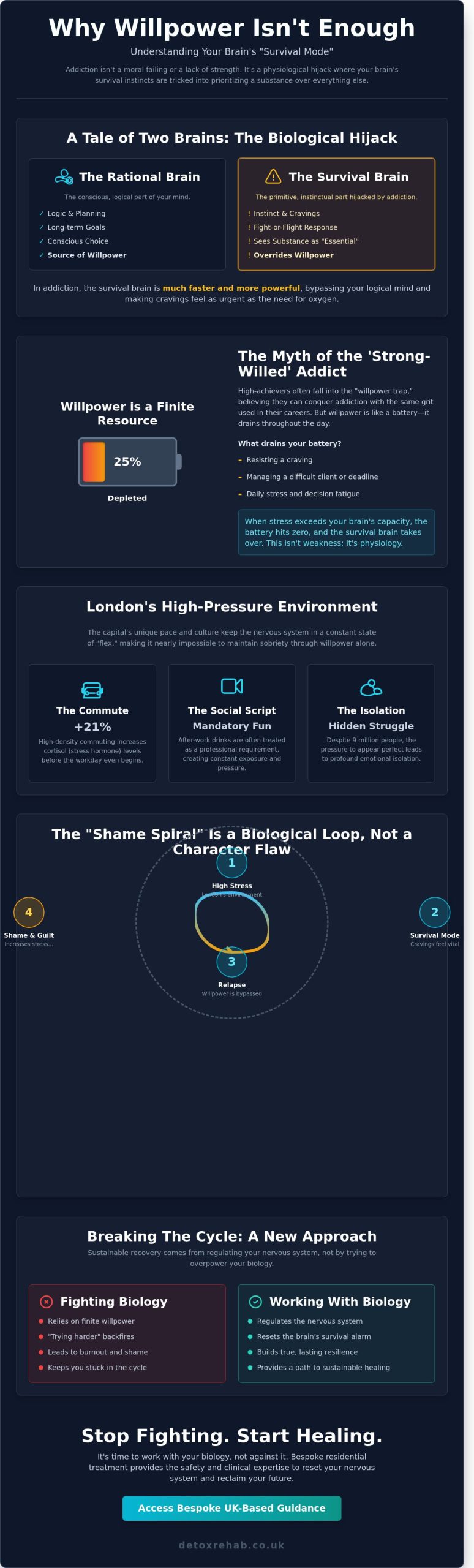
You have likely spent years building a reputation for resilience. In the high-stakes environments of the City or the legal chambers of the Temple, grit is the currency of success. You manage multi-million pound portfolios and lead complex teams, yet you find yourself unable to control your relationship with a substance. This disconnect creates a profound sense of shame. It’s vital to understand that your professional success hasn’t translated to sobriety because willpower is a finite physiological resource, not a reflection of your character. Why Willpower Isn’t Enough: Understanding Your Brain’s “Survival Mode” involves recognising that addiction is a complex neuropsychological disorder that physically alters the brain’s decision-making pathways.
The traditional British “stiff upper lip” often serves as a barrier to true healing. This cultural expectation suggests that admitting a lack of control is a sign of weakness. In reality, “Survival Mode” is a state where the primitive parts of your brain prioritise a substance over logic, safety, and even loved ones. When you’re in this state, your brain perceives the substance as necessary for survival, much like air or water. No amount of mental toughness can simply “think” its way out of a biological hijack.
The Myth of the ‘Strong-Willed’ Addict
High-achievers in London are frequently more prone to the “willpower trap” because they’ve used discipline to conquer every other area of life. You might be “functioning”-attending every 8:00 AM meeting and hitting your targets-but true recovery is different from merely surviving the week. Willpower acts like a battery. It drains every time you resist a craving or manage a difficult client. The moment your stress levels exceed your brain’s regulatory capacity, that battery hits zero. This is why Why Willpower Isn’t Enough: Understanding Your Brain’s “Survival Mode” is a concept that resonates; it explains why you “snap” after a long, successful day and return to old habits.
London’s High-Pressure Catalyst
The pace of life in Canary Wharf or the West End keeps the human nervous system in a constant state of “flex.” This chronic activation of the sympathetic nervous system makes it nearly impossible to maintain sobriety through effort alone. Consider the unique environmental triggers found in the capital:
- The Commute: The 2023 London Transport survey noted that high-density commuting increases cortisol levels by 21% before you even reach your desk.
- The Social Script: After-work drinks are often treated as a mandatory professional requirement rather than a choice.
- The Isolation: Despite the density of 9 million people, the professional pressure to appear perfect often leads to profound emotional isolation.
Trying to “white-knuckle” your recovery in such a high-pressure environment is a recipe for relapse. We provide the clinical expertise to help you move beyond grit and into a structured, bespoke plan for lasting change.
The Neuroscience of Survival Mode: How Addiction Rewires the Brain
When you struggle with dependency, it often feels like a moral failing or a lack of strength. However, the reality is rooted in your biology. Your brain operates on a strict hierarchy of survival, prioritizing air, water, food, and safety. In a healthy brain, these needs are balanced by the logical mind. When addiction takes hold, the midbrain, which is responsible for survival, is tricked into believing the substance is as essential as oxygen. This explains Why Willpower Isn’t Enough: Understanding Your Brain’s “Survival Mode” is vital for your recovery journey. You aren’t choosing to prioritize a substance over your family or career; your survival circuitry has been high-jacked.
This biological shift happens because the midbrain is much faster and more powerful than the rational parts of your brain. It processes threats and rewards in milliseconds. Once the brain identifies a substance as a survival requirement, it will bypass your logic to ensure you “survive” by consuming it. This is why we focus on clinical strategies rather than just grit; we’re working to reset a system that’s functioning in a state of constant emergency.
The Amygdala vs. The Prefrontal Cortex
The Amygdala acts as your brain’s smoke detector, and during addiction, it remains permanently switched to the ‘on’ position. While this part of the brain scans for threats, the Prefrontal Cortex, your internal CEO, manages logic and long-term consequences. During an intense craving, the Prefrontal Cortex effectively goes offline, leaving the “alarm” to run the show. The chronic stress of London life, where 24 percent of residents report high anxiety levels according to ONS data, further weakens the neural pathways of self-control. This makes it significantly harder for your logical mind to override the survival signals being sent by the Amygdala.
Dopamine and the Reward Circuitry
Substances flood your brain with dopamine at levels that far exceed any natural reward. While a good meal or a walk in a park might provide a gentle ripple of pleasure, drugs or alcohol create a tidal wave. This process is a core part of the Science of Addiction, as it forces the brain to downregulate its own dopamine production to protect itself. However, as the brain heals, many find that pursuing safe, high-adrenaline activities like UK Skydiving can help rediscover a natural sense of exhilaration and reward.
- The Anhedonia Phase: Because your brain has lowered its natural dopamine sensitivity, everyday London life can feel grey and dull during early recovery.
- The Survival Scream: When you encounter a stressor, your brain “screams” for the substance because it no longer knows how to find balance without it.
- Neuroplasticity: Your brain was rewired through repetition, and while it can be rewired back, it requires a structured environment to do so safely.
Understanding Why Willpower Isn’t Enough: Understanding Your Brain’s “Survival Mode” helps remove the heavy burden of shame. Your brain has adapted to a difficult situation, and now it needs professional guidance to find its way home. If you feel trapped in this cycle, we can help you navigate the bespoke treatment options available to reclaim your life.
Why ‘Trying Harder’ Backfires: The Physiology of Relapse
Think of your willpower like a flexed bicep. If you hold a heavy weight for long enough, the muscle eventually spasms and fails. You cannot force a cramped system to relax by simply squeezing tighter. When you rely solely on “grit” to stay sober, you’re asking a fatigued brain to perform a marathon every single day. This is why willpower isn’t enough: understanding your brain’s “survival mode” requires acknowledging that your biology has its own hardwired limits.
Your Reticular Activating System (RAS) acts as a high speed filter for your environment. In a city as dense as London, your RAS is constantly bombarded with stimuli. If your brain is wired for addiction, it will subconsciously scan for the familiar glow of a pub sign in Soho or the specific street corner where you once used. This isn’t a moral failing; it’s your brain’s internal GPS pointing toward what it perceives as a survival necessity. We understand that you aren’t choosing these triggers, your brain is simply highlighting them because it hasn’t yet learned to prioritise new, healthier signals.
Most relapses occur after 5:00 PM because of a phenomenon known as decision fatigue. After a ten hour workday navigating the City or commuting on the Jubilee Line, your prefrontal cortex is depleted. You’ve used your “no” muscle a thousand times already. By the time you reach the station, your logical brain is effectively offline. Expecting yourself to recover alone is like trying to set a broken leg without a splint. You wouldn’t expect a fractured bone to heal while you’re running on it, and your brain needs the same clinical support to mend.
The Exhaustion of Hyper-Vigilance
Staying “on guard” consumes an immense amount of glucose. Research indicates that self control is a finite resource that burns through physical energy. When you’re constantly monitoring your thoughts to avoid a lapse, your “Safety Filter” eventually shuts down. This creates a state of cognitive tunnel vision where logical solutions disappear. In the high pressure London environment, this often triggers an “all or nothing” mindset. You might feel that a single moment of weakness means your entire recovery is over, but this is merely a symptom of an exhausted nervous system.
The Role of Cortisol and Adrenaline
The “London hustle” keeps your body in a state of chronic stress. This raises your cortisol levels, which can be significantly higher in urban professionals compared to those in less frantic environments. When cortisol stays high, your brain desperately seeks a “downer” like alcohol or opioids to find chemical balance. This physiological drive makes it nearly impossible to “think” your way out of a craving. A structured detoxification process is essential to clear this stress chemical backlog. It allows your nervous system to reset to a baseline of calm, providing the foundation you need for a new beginning.
Breaking the Cycle: Regulating the Nervous System in the Capital
Recovery isn’t a test of your character; it’s a process of recalibrating your physiology. When you’re trapped in a cycle of craving, your body is operating under the belief that the substance is necessary for survival. This biological hijacking is exactly Why Willpower Isn’t Enough: Understanding Your Brain’s “Survival Mode”. To heal, we must shift our focus from “mental control” to “physiological regulation.” We need to teach your nervous system that it’s safe to let go.
In the high-pressure environment of London, your “fight or flight” response is often stuck in the “on” position. The constant noise, the frantic commute, and the intense workplace demands create a backdrop of chronic stress. This stress feeds the addiction loop. By learning to regulate your nervous system, you can begin to create a gap between the trigger and the reaction. This isn’t about ignoring the craving. It’s about calming the physical alarm before it becomes overwhelming.
Somatic Regulation in an Urban Environment
Grounding yourself in the city requires practical, somatic tools. For London commuters, breathwork is a portable and effective way to signal safety to the brain. Techniques like “box breathing” can be practiced on the Tube or in the office to lower heart rates. Utilising London’s green spaces is also vital. A 2019 study published in Scientific Reports suggests that spending 120 minutes a week in nature, such as Hyde Park or Richmond Park, significantly improves health and well-being. These spaces provide a necessary reset for a frayed nervous system. However, for those facing severe dependency, these tools serve as supportive measures rather than a primary cure. Clinical intervention remains the safest path to stability.
The Necessity of a ‘Clinical Circuit Breaker’
Sometimes, the only way to stop the “Survival Mode” loop is to remove yourself from the environment that created it. Residential treatment acts as a vital circuit breaker. By leaving the triggers of London for a dedicated centre, you give your brain the space it needs to heal. In these facilities, you’re supported by a 24/7 medically supervised team. This environment ensures your safety during the most vulnerable stages of recovery. Professional detox centres in the UK follow strict Care Quality Commission (CQC) guidelines to manage the physical survival response, providing a level of care that’s impossible to replicate at home. This structured environment replaces chaos with stability, allowing you to focus entirely on your restoration.
Finding Safety: Private Addiction Treatment and Referrals in London
Recovery begins when you stop fighting your biology and start working with it. Understanding Why Willpower Isn’t Enough: Understanding Your Brain’s “Survival Mode” helps you see that addiction is a physiological state, not a moral failing. Detox Rehab Clinics UK serves as your steady guide through London’s intricate treatment landscape. We offer a bespoke approach that identifies your unique “Survival Mode” triggers and matches them with a clinic equipped to help you reset. You don’t have to navigate this alone; we provide the clinical authority and empathetic support needed to bridge the gap between crisis and stability.
Navigating London’s Treatment Options
Accessing help through the NHS often involves waiting lists that can stretch for 18 to 24 weeks for intensive residential care. For someone in the grip of a “survival mode” response, this delay is often too long to manage. We provide immediate private referrals to a network of over 300 high-quality centres across the UK. This speed is vital for London professionals who need to address their health without a prolonged public wait. We vet each facility to ensure they meet rigorous safety and clinical standards, focusing on those that offer total confidentiality and discretion.
The right placement must address the complexities of your life in the city. This is especially vital for Londoners facing co-occurring disorders. National statistics indicate that approximately 59% of adults starting treatment for drug use also require mental health support. Our referral process prioritises dual-diagnosis care, ensuring that your treatment plan tackles both the addiction and underlying issues like clinical anxiety, depression, or high-pressure work stress. We look for programmes that offer:
- Immediate admission to bypass dangerous waiting periods.
- Specialist medical detoxification supervised by experienced clinicians.
- Bespoke therapy plans that address the specific triggers of your survival response.
- Total privacy for high-profile individuals or corporate professionals.
Your Path to a New Beginning
Taking the first step doesn’t require a massive reservoir of willpower you don’t currently feel you have. It requires a single moment of honesty. When you contact our London-based advisory team, you’ll speak with experts who understand the pressures of city life and the weight of professional responsibilities. We provide 24/7 availability and a non-judgmental environment where your story is heard with compassion. We take the burden of research and logistics off your shoulders, handling every detail of the referral process.
Our goal is to move you from a place of fear to a place of clinical safety. We provide the structure you need when your own internal resources are depleted. By matching you with the right residential setting, we help you reclaim your life and build a foundation for long-term healing. You’ve been operating in survival mode for long enough; it’s time to step into a space designed for your recovery.
Contact Detox Rehab Clinics UK for a free, confidential assessment. Our team is ready to help you find the right path forward, right now.
Reclaiming Your Life From Survival Mode
Recovery isn’t a test of your character; it’s a physiological process that requires expert intervention. We’ve explored how addiction rewires your neural pathways, making it clear Why Willpower Isn’t Enough: Understanding Your Brain’s “Survival Mode” is the first step toward true freedom. When your nervous system is stuck in a state of high alert, “trying harder” often triggers the very stress that leads back to substance use. Real change happens when we move from grit to regulation, creating a sense of safety within your own body.
At Detox Rehab Clinics UK, we provide independent advice across 300+ UK centres to ensure you find a bespoke environment that fits your specific needs. Our London-based addiction specialists offer expert guidance, helping you navigate the complexities of residential treatment with clinical authority and genuine care. You don’t have to wait for a crisis to reach out. We provide 24/7 immediate support and referrals, ensuring you’re never alone in this process.
Start your recovery journey today with a free London consultation. You’ve carried this weight for long enough. It’s time to let us help you find the way back to yourself.
Frequently Asked Questions
Why is my willpower not enough to stop my addiction?
Your willpower isn’t enough because addiction is a physiological condition that alters the brain’s reward circuitry and executive function. Research from the National Institute on Drug Abuse indicates that chronic substance use can reduce dopamine receptor density by up to 20 percent. This makes it physically impossible to “choose” your way out of a craving using logic alone. Understanding Why Willpower Isn’t Enough: Understanding Your Brain’s “Survival Mode” helps you realise that your prefrontal cortex, the part of the brain responsible for decisions, is effectively offline during a crisis.
What does ‘survival mode’ feel like in the brain?
Survival mode feels like a primal, overwhelming necessity where the substance is perceived as essential for life as oxygen or water. When your brain enters this state, the amygdala becomes hyperactive, triggering a 30 percent increase in cortisol levels. You might experience tunnel vision, rapid heartbeat, and a total inability to focus on anything other than the next dose. It’s a state of high-alert distress that bypasses your rational mind entirely, leaving you feeling trapped in a cycle of panic and relief.
Can I detox from alcohol safely at home in London?
You can only detox from alcohol safely at home if you’re under the direct supervision of a GMC-registered doctor who provides a bespoke medical plan. Unmanaged alcohol withdrawal carries a 5 percent mortality rate due to potential complications like Delirium Tremens. We provide clinical home detox services in London that include 24/7 phone support and prescription medications, such as Chlordiazepoxide, to manage your symptoms. This ensures your safety while allowing you to begin your recovery journey in a familiar, private environment.
How long does it take for the brain to rewire after addiction?
Significant structural healing in the brain typically takes between 6 and 18 months of sustained abstinence. A study published in the Journal of Neuroscience found that it takes approximately 14 months for dopamine transporter levels in the brain to return to a baseline state. While the initial 14 days of detox clear the physical toxins, the restorative process of neuroplasticity requires time and consistent therapeutic support. We guide you through this timeline, providing the tools needed to support your brain’s natural ability to heal.
Why do I feel more cravings when I’m stressed at work in London?
Stress triggers the release of Corticotropin-Releasing Hormone (CRH), which directly activates the brain’s craving pathways. In the high-pressure environments of the London corporate sector, 40 percent of professionals report that stress is a primary driver for their substance use. When your cortisol spikes, your brain seeks an immediate chemical “safety” to return to equilibrium. We help you develop bespoke coping mechanisms that interrupt this stress-response cycle, allowing you to manage your professional responsibilities without relying on harmful substances.
What is the difference between a habit and a ‘survival mode’ addiction?
A habit is a learned behaviour that you can modify through conscious effort, whereas a ‘survival mode’ addiction is a deep-seated physiological compulsion. Why Willpower Isn’t Enough: Understanding Your Brain’s “Survival Mode” is clear when we look at brain scans; habits involve the basal ganglia, but addiction involves a total hijacking of the midbrain’s survival systems. In addiction, the brain prioritises the substance over food, sleep, and social bonds, which isn’t the case with a standard habit like biting your nails.
How do I know if I need residential rehab or just outpatient support?
You likely need residential rehab if you have a score of 15 or higher on the Alcohol Use Disorders Identification Test (AUDIT) or have experienced multiple relapses in the past. Residential treatment provides a 24-hour clinical environment that removes you from local triggers and ensures your safety during the most vulnerable stages of recovery. Outpatient support is often suitable for those with a stable home life and a lower risk of severe physical withdrawal. We provide a full clinical assessment to determine which pathway offers you the best chance of a permanent new beginning.
Is private rehab in London confidential for high-profile professionals?
Yes, private rehab in London is strictly confidential and operates under the Data Protection Act 2018 and CQC regulations to ensure your total anonymity. We understand the unique pressures faced by high-profile individuals and offer bespoke treatment plans that include Non-Disclosure Agreements (NDAs). Our clinics provide private entrances and individualised schedules to ensure you never encounter other patients. You can reclaim your life and health with the peace of mind that your professional reputation remains entirely protected throughout the healing process.