

What if the one thing you fear will end your career in the City is actually the strategic move that saves it? You likely feel that admitting to a struggle with alcohol or substances is an immediate ticket to a “conduct risk” dismissal, especially with the Financial Conduct Authority (FCA) maintaining such rigorous oversight. It’s a terrifying position to be in, feeling as though you must choose between your health and your livelihood in an environment where 1 in 7 UK finance professionals report feeling “highly stressed” according to 2023 industry surveys. We understand this fear, but the reality of The “Fit and Proper” Test: Can Seeking Rehab Actually Save Your Career in Finance? is often more supportive than you might imagine.
You’ll discover how taking proactive steps toward residential treatment demonstrates the exact integrity and self-regulation that the FCA’s FIT 1.3 standards require. This article explains how a clinical intervention can prevent a forced disclosure and align your recovery with your professional obligations. We provide a clear roadmap for navigating this journey with total confidentiality, helping you move from the weight of shame toward a new beginning in your career.
Key Takeaways
- Understand how the FCA’s Senior Management and Certification Regime (SM&CR) values proactive honesty, ensuring your professional integrity remains intact during challenging times.
- Learn why addressing substance use is a critical step in managing ‘conduct risk’ and protecting yourself against the potential for professional coercion or compromised decision-making.
- Gain clarity on The “Fit and Proper” Test: Can Seeking Rehab Actually Save Your Career in Finance? and discover why transparency is always preferred over discovery by City regulators.
- Identify the essential criteria for choosing executive-level residential programmes that prioritise your absolute confidentiality while you focus on long-term healing and self-regulation.
- Discover how our specialist advisory service acts as a steady guide, matching you with the UK’s most discreet private clinics to help you reclaim both your health and your career.
Understanding the ‘Fit and Proper’ Test in London’s Financial Sector
If you work in the City or Canary Wharf, you’re likely familiar with the Senior Management and Certification Regime (SM&CR). At its heart lies the Fit and Proper test. It’s the benchmark the Financial Conduct Authority (FCA) uses to ensure you’re suitable for your role. While it once focused primarily on your technical ability or financial history, the criteria now extend deep into your personal conduct. You might find yourself asking, The “Fit and Proper” Test: Can Seeking Rehab Actually Save Your Career in Finance? The answer lies in how firms now perceive risk and recovery.
Modern compliance departments don’t view addiction as a moral failing. They see it as a conduct risk. If a trader, broker, or executive struggles with substance use, their decision-making becomes unpredictable. This creates a liability for the firm. We understand the immense pressure of London’s financial markets. We know that high-stakes environments can often lead to coping mechanisms that eventually spiral out of control. Acknowledging this isn’t the end of your career; it’s often the first step in protecting it.
The Three Pillars of Fitness and Propriety
The FCA’s FIT handbook breaks down your suitability into three distinct areas. First is honesty, integrity, and reputation. Your personal behaviour, even outside the office, impacts your professional standing. Second is competence and capability. Substance misuse directly impairs the cognitive functions required to perform high-level tasks. Third is financial soundness. There’s a documented link between addiction and financial instability. The FCA views personal debt or erratic spending as a potential gateway to internal fraud or market abuse.
Why London Firms are Increasing Scrutiny
Since the FCA’s 2024 prioritisation of non-financial misconduct, London firms have become hyper-vigilant. The ‘work hard, play hard’ culture that once defined the City is being replaced by strict oversight. Compliance Officers are now trained to look for early warning signs of dependency, such as increased absenteeism or erratic temperaments. They know that an untreated problem is a ticking clock.
- Regulatory Pressure: The FCA’s 2024 “Culture and Non-Financial Misconduct” survey shows a 25% increase in firms reporting internal conduct issues.
- Risk Management: A senior staff member under the influence is a liability that no insurance policy can fully cover.
- Duty of Care: Firms are moving toward supportive frameworks, preferring to see a valuable employee enter a residential treatment programme rather than face a public regulatory failure.
Choosing to enter a detoxification and recovery programme shows that you’re taking responsibility for your “fitness” to work. It’s a proactive move. By addressing the root cause of the risk, you’re demonstrating the very integrity the SM&CR demands. We’re here to help you navigate this journey with total confidentiality and expert care.
How Addiction Compromises Your Regulatory Standing
The Financial Conduct Authority (FCA) views your personal conduct as a direct reflection of your professional suitability. Under the FIT 1.1 section of the FCA Handbook, the regulator assesses honesty, integrity, and reputation. When substance use enters the frame, it creates a “Conduct Risk” that the City can’t ignore. You might feel you’re managing, but the slippery slope from social use to regulatory non-compliance is often steeper than it looks. For those in intelligence-sensitive or high-security roles, addiction introduces a vulnerability to blackmail or coercion. This isn’t just a health issue; it’s a security breach waiting to happen.
Unaddressed problems lead to inevitable breaches of Principle 1, which focuses on Integrity. If your judgement is clouded, you can’t uphold the high standards required by the Senior Managers and Certification Regime (SM&CR). Understanding The “Fit and Proper” Test: Can Seeking Rehab Actually Save Your Career in Finance? starts with acknowledging how quickly a private struggle becomes a public regulatory failure. We believe that recovery is the only way to protect the career you’ve worked so hard to build.
Impaired Decision-Making and Competence
Clinical research shows that chronic alcohol or drug use impairs the prefrontal cortex. This is the area responsible for risk assessment and impulse control. The myth of the “high-functioning” addict is something we see often, but the FCA is increasingly sceptical. In 2023, the regulator’s focus on non-financial misconduct highlighted that personal behaviour is inextricably linked to professional competence. Errors in judgement caused by intoxication or withdrawal can lead to catastrophic trading mistakes. We’ve seen cases where lack of oversight or impaired decision-making contributed to fines exceeding £10 million for firms and individuals alike.
The Financial Soundness Trap
Your personal finances are a key pillar of the “Fit and Proper” criteria. Addiction is expensive, often leading to hidden debt or depleted savings. The FCA views financial distress as a significant risk factor for insider trading or fraud. If you’re struggling with “Financial Soundness,” the regulator may conclude you’re a liability.
- Personal debt can trigger automatic red flags during annual fit and proper assessments.
- Bankruptcy or Individual Voluntary Arrangements (IVAs) must be disclosed and often lead to the withdrawal of approval.
- The regulator sees financial desperation as a primary motive for professional dishonesty.
We understand the pressure you’re under. If you’re worried about your standing, seeking professional support early can help you regain control before the regulator intervenes. It’s about more than just your health; it’s about whether The “Fit and Proper” Test: Can Seeking Rehab Actually Save Your Career in Finance? remains a question you can answer with confidence.
Recovery as a Regulatory Asset: The Case for Disclosure
The Financial Conduct Authority (FCA) operates on a foundation of trust. When you face a dependency issue, your first instinct might be to retreat and hide. However, in the high-stakes environment of the City, the FCA prioritises transparency over discovery every time. If the regulator or your firm discovers a problem through an error or a whistleblower, it is viewed as a failure of oversight. When you choose to step forward, you shift the narrative from a liability to a managed recovery. This proactive stance is often the deciding factor in The “Fit and Proper” Test: Can Seeking Rehab Actually Save Your Career in Finance? by proving you possess the self-awareness required for senior roles.
Completing a residential rehab programme acts as a powerful form of self-regulation. It provides a structured environment where you can address the root causes of your behaviour while under medical supervision. From a regulatory perspective, this is seen as “mitigation.” You are taking active, documented steps to remove a risk to the firm and its clients. We have seen that professionals who engage with treatment early are far more likely to retain their status than those who wait for a crisis to force their hand.
Demonstrating Integrity through Honesty
The first pillar of the Fit and Proper test is integrity. Admitting you have a problem and seeking help doesn’t diminish your standing; it reinforces it. Voluntary disclosure shows you value the safety of the markets and the reputation of your firm above your own ego. The difference between voluntary disclosure and investigative discovery is the difference between a career pause and a career end. The FCA views the act of self-reporting a health-related struggle as a definitive mark of professional maturity and ethical responsibility.
- Transparency: Builds a bridge of trust with Compliance and HR departments.
- Evidence of Change: A clinical discharge summary provides tangible proof of your fitness to return.
- Risk Management: Shows you can identify and neutralise personal risks before they impact the business.
Maintaining Your Authorisation During Treatment
Many finance professionals fear that entering a clinic means an immediate loss of their “approved person” status. This isn’t necessarily true. Under the FCA Handbook (specifically SUP 10C.14), the “12-week rule” allows a firm to appoint an individual to cover a Senior Management Function (SMF) for up to 12 weeks in any consecutive 12-month period without seeking new authorisation. This window is often the perfect length for a comprehensive residential treatment programme and a phased return to work.
When you sit down with HR or Compliance, we recommend presenting a structured recovery plan rather than just a problem. This plan should outline your treatment dates, the support systems you will have in place upon your return, and how you will manage your responsibilities during your absence. By providing this roadmap, you transform a medical emergency into a managed transition. It allows your firm to support your healing while staying compliant with the The “Fit and Proper” Test: Can Seeking Rehab Actually Save Your Career in Finance? requirements, ensuring your seat is still there when you are ready to reclaim it.
Navigating Rehab in London: Options for High-Stakes Professionals
Finding a path to recovery while maintaining a high-pressure role in the City requires more than just a standard clinical approach. You need a setting that respects the gravity of your professional standing and the unique stressors of your environment. When considering The “Fit and Proper” Test: Can Seeking Rehab Actually Save Your Career in Finance?, the choice of facility is a vital piece of evidence for the FCA. It demonstrates your commitment to a permanent solution rather than a temporary fix.
We understand that for senior staff, a complete disconnection from the office can sometimes create more anxiety than it relieves. Bespoke care often includes managed work access; this allows you to handle critical tasks for a set hour each day while remaining focused on your clinical progress. A private detox ensures this transition is safe and medically supervised. It removes the physical barriers to recovery so you can engage fully with the psychological work ahead. This structured medical intervention is often the first step in reclaiming your life and your professional reputation.
Choosing the Right Treatment Centre
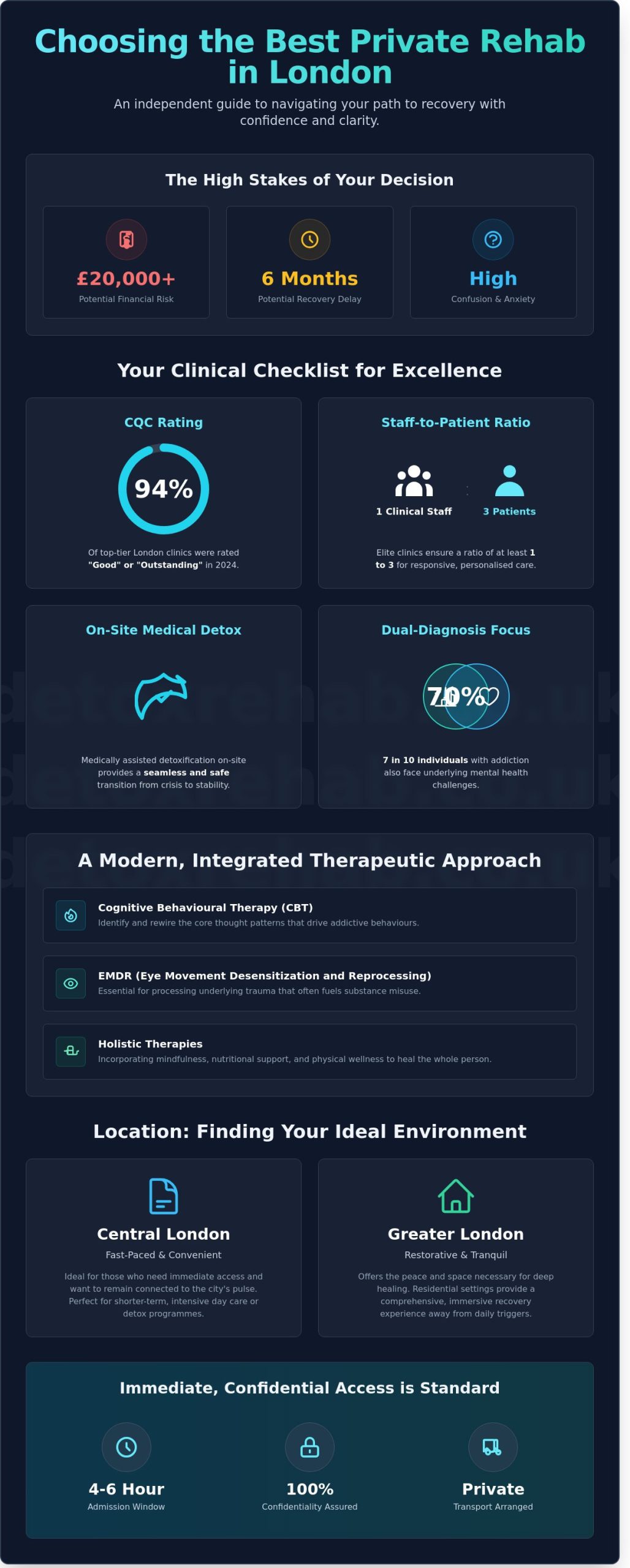
Your search should begin with CQC ratings. A “Good” or “Outstanding” rating from the Care Quality Commission is non-negotiable for clinical safety. Discretion is equally paramount. In London, luxury clinics provide peer-group relevance; you’ll be recovering alongside individuals who understand the weight of managing multi-million pound portfolios. Residential treatment away from the triggers of Canary Wharf or Mayfair provides the necessary distance to reset your baseline. It’s about healing in an environment where your professional identity is respected but your health is the priority. According to the CQC 2023/24 State of Care report, high-quality residential services are essential for those with complex, dual-diagnosis needs who require a secure, clinical setting.
Managing the ‘City’ Lifestyle Post-Rehab
The transition back to the office is often where the real work begins. London’s financial culture remains heavily tied to client entertainment and late-night networking. You’ll need to develop a robust “sober network” within the industry. Statistics from the City Mental Health Alliance suggest that peer support is a major factor in long-term success. Aftercare programmes are the key to preventing a regulatory-ending relapse. They provide a structured safety net as you re-enter the fast-paced world of finance with a new perspective. Ultimately, passing The “Fit and Proper” Test: Can Seeking Rehab Actually Save Your Career in Finance? depends on your ability to maintain these new boundaries over the long term. The FCA’s 2024 focus on non-financial misconduct means your recovery journey is now a matter of significant regulatory interest.
How Detox Rehab Clinics UK Protects Your London Career
Navigating the intersection of personal health and professional regulation requires a delicate, expert hand. At Detox Rehab Clinics UK, we act as your independent, confidential advisory service, bridging the gap between clinical necessity and the stringent requirements of the City. We don’t just find you a bed; we provide a strategic clinical shield. Our team understands that for a senior executive, the question of The “Fit and Proper” Test: Can Seeking Rehab Actually Save Your Career in Finance? is often met with silence from internal HR departments. We fill that void with absolute discretion and professional expertise.
Our primary role involves matching you with the UK’s most exclusive private clinics—including specialized providers like CLEAN AND FREE THERAPY®—ensuring your environment reflects your professional standing and personal needs. We combine deep clinical authority with an intimate knowledge of the high-pressure finance sector. This dual expertise allows us to advocate for your health while respecting the nuances of your authorisation status. Because the markets never sleep, our 24/7 availability is a cornerstone of our service. Whether it’s 3:00 AM on a Tuesday or the height of a quarterly reporting cycle, we’re ready to facilitate your transition into care without delay.
A Bespoke Path to Recovery
Time is a luxury you likely don’t have when your reputation is on the line. We facilitate immediate admissions, often within 24 hours, to prevent a manageable health issue from spiralling into a workplace catastrophe. Because we’re independent, we work for you, not the clinic. This means our recommendations are unbiased and entirely focused on your unique clinical profile. We ensure your recovery plan is robust enough to satisfy medical standards while providing the framework you need to maintain your professional integrity. We’ll help you find a programme that treats the individual, not just the symptoms.
Take the First Step Toward Career Preservation
Total confidentiality is our baseline. Your firm doesn’t need to be involved in our initial discussions, and we take every precaution to protect your identity throughout the process. Waiting for a visible crisis is often the only way to truly lose your authorisation. By taking control now, you’re not just healing; you’re protecting your livelihood. Contact our London advisory team today for a free, discreet assessment and discover how The “Fit and Proper” Test: Can Seeking Rehab Actually Save Your Career in Finance? can be answered with a resounding yes through the right clinical support. Don’t let another day of uncertainty jeopardise everything you’ve built.
Taking Control of Your Regulatory Standing
Choosing to address addiction isn’t just a personal health decision; it’s a strategic move to preserve your integrity under the FCA’s Senior Managers and Certification Regime. The “Fit and Proper” Test: Can Seeking Rehab Actually Save Your Career in Finance? The answer is often a definitive yes, provided you act with the transparency that regulators demand. By opting for clinical intervention now, you demonstrate the honesty and self-regulation essential to high-stakes roles in the City. This proactive approach transforms a potential liability into a documented commitment to professional standards.
We provide independent advice on over 300 UK centres, ensuring you find a facility that understands the unique pressures of the financial sector. Our specialists focus on executive-level private referrals where total confidentiality is guaranteed. You’ve built a successful career through discipline and foresight. Applying those same principles to your recovery helps you return to the boardroom with renewed strength and a clear path forward. It’s time to reclaim your health and your professional reputation.
Protect your career and your health—speak with our London specialists today
Frequently Asked Questions
Will the FCA automatically ban me if I admit to an addiction?
No, the FCA doesn’t automatically ban individuals for disclosing a health condition or addiction. Under the FIT handbook Section 2.2, the regulator focuses on your honesty and how you manage the situation. Proactively seeking treatment often demonstrates the integrity required to remain “fit and proper” in your role. We’ve seen that transparency combined with a clear recovery plan is viewed more favourably than hiding a problem.
Can I keep my job in the City while attending a residential rehab?
Yes, your employment is protected under the Equality Act 2010 if your condition is classified as a disability or long-term health issue. Most City firms have Private Medical Insurance (PMI) policies that specifically cover mental health and addiction treatment. Taking a structured leave of absence for medical reasons is a standard HR procedure that doesn’t result in immediate termination of your contract.
What is the difference between a health issue and a conduct issue in the eyes of the FCA?
A health issue involves a medical condition like dependency, while a conduct issue relates to a breach of integrity or dishonesty. The FCA’s FIT 2.2.1 guidance notes that a physical or mental health condition doesn’t automatically imply a lack of fitness. However, hiding an addiction or committing fraud to fund it becomes a conduct issue that seriously threatens your professional status and career longevity.
How do I explain a 28-day absence to my firm without revealing my addiction?
You can cite “medical grounds” or “stress-related leave” supported by a GP’s fit note to cover your absence. Under UK GDPR and the Access to Medical Reports Act 1988, you aren’t forced to disclose a specific diagnosis to your line manager. HR must maintain strict confidentiality regarding the exact nature of your residential treatment while you focus on your healing and empowerment.
Are London rehab clinics truly confidential for high-profile individuals?
Specialist London clinics operate under strict CQC regulations and the Data Protection Act 2018 to ensure total privacy. Facilities designed for finance professionals often use discreet locations and non-disclosure agreements (NDAs) to protect your identity. We ensure your presence remains entirely private, allowing you to undergo detoxification and residential treatment without any risk to your public reputation or standing in the City.
What happens if a colleague reports my substance use to the Compliance officer?
Compliance must investigate the report, but self-reporting your intent to seek treatment usually mitigates the outcome. If you’ve already started the “Fit and Proper” Test: Can Seeking Rehab Actually Save Your Career in Finance? process, it shows you’re taking responsibility for your actions. Firms often prefer supporting a professional recovery plan over the legal complexities and costs of a dismissal.
Does the ‘Fit and Proper’ test apply to junior staff or just senior managers?
The test applies to all “Certified Persons” and “Senior Managers” under the SM&CR (Senior Managers and Certification Regime) introduced in 2016. While senior managers face more intense scrutiny, even junior staff must meet the FIT requirements for honesty, integrity, and reputation. Everyone in a regulated role must prove they can perform their duties reliably and ethically to maintain their certification, sometimes utilizing resources like Courses Court Ordered to address specific compliance or legal obligations.
How can I find a rehab centre in London that caters specifically to finance professionals?
You should look for CQC-registered facilities in areas like Marylebone or Chelsea that offer bespoke executive programmes. These centres understand the high-pressure environment of the City and provide detoxification schedules that respect your professional needs. Understanding The “Fit and Proper” Test: Can Seeking Rehab Actually Save Your Career in Finance? is easier when you have a clinical team that understands the UK financial sector.